

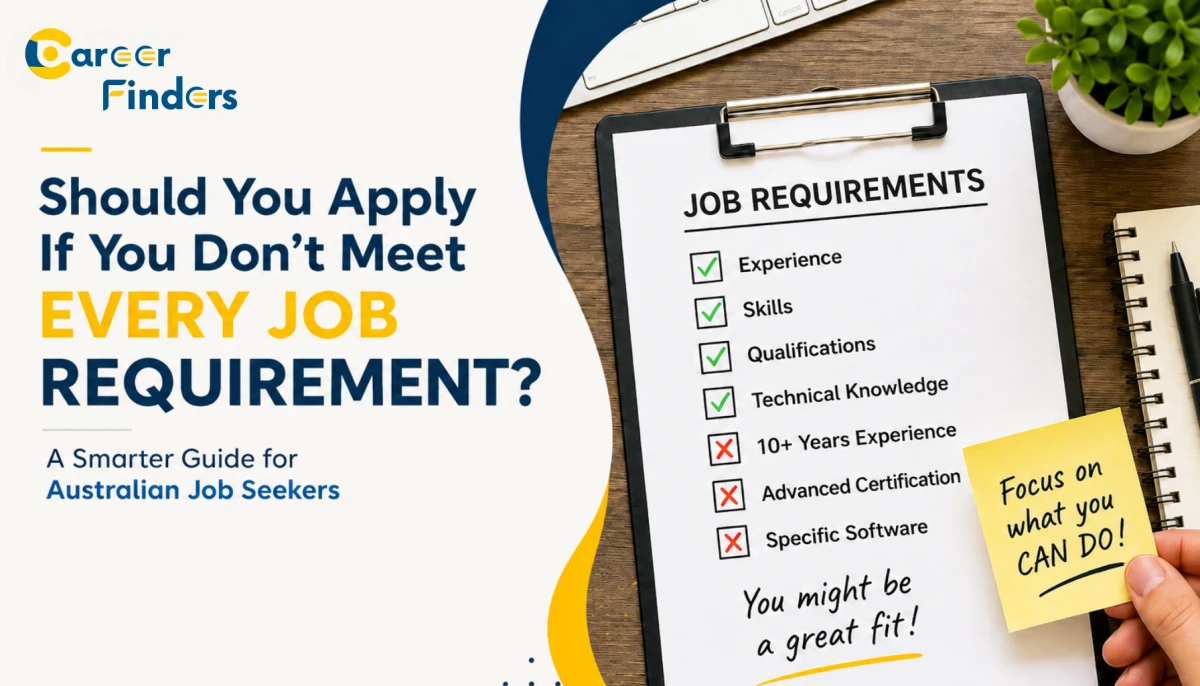
Have you ever found a job that looked perfect, started reading the requirements and then stopped yourself from applying?
Maybe the employer wanted five years of experience and you had three. Perhaps you knew most of the software listed but had never used one particular system. Or the advertisement mentioned a qualification you did not have even though you had practical experience doing similar work.
Many job seekers make the same decision:
“I don’t meet everything, so there is no point applying.”
But a job advertisement is not always a checklist where missing one item automatically disqualifies you.
Australian employers are operating in a labour market where finding the right combination of skills and experience can still be difficult. Jobs and Skills Australia reported that 44% of employers surveyed were recruiting in July 2026, while 43% of recruiting employers reported recruitment difficulty.
At the same time, Australia is increasingly discussing a skills-first approach that gives greater recognition to what people can actually do, including transferable capabilities such as communication, analytical thinking and problem-solving.
So, should you apply when you do not meet every requirement?
Often, yes—but you need to know which requirements you can realistically stretch and which ones you cannot.
Employers usually create job descriptions around the person they believe would perform the role successfully.
That description may include:
The problem begins when candidates interpret every bullet as equally important.
They are not always equal.
A requirement such as a legally required professional registration can be fundamentally different from a statement such as “experience with Salesforce preferred.”
The first may prevent you from legally or safely performing the role. The second may be something an employer can teach the right candidate.
Instead of immediately asking:
“Do I meet everything?”
Ask:
“Can I perform the important parts of this job, and can I prove it?”
That is a much more useful way to assess an opportunity.
Job advertisements frequently use words that reveal how important a requirement actually is.
Pay close attention to language such as:
Essential / Required / Must Have
These requirements are generally more important and should be assessed carefully.
Examples could include:
Then there are requirements described as:
Preferred / Desirable / Advantageous / Ideally
These usually allow more flexibility.
For example:
“Experience with Xero desirable.”
If you have strong accounting experience and have used another accounting system extensively, lacking Xero experience alone may not justify rejecting yourself.
You could instead explain how quickly you have learned similar platforms.
Imagine a job advertisement contains ten requirements.
A candidate meets seven.
Another candidate meets eight.
That does not automatically make the second candidate stronger.
What matters is which requirements they meet and how relevant their experience is.
Suppose an employer needs someone to manage client enquiries, solve customer problems and coordinate internal teams.
One candidate may tick many minor requirements but have weak customer-facing experience.
Another may lack one software skill but have four years of excellent client-management experience.
The second person could potentially offer more value.
Before deciding whether to apply, identify the three or four capabilities that appear central to the position.
Look for responsibilities that are:
Those are usually the areas your application should prioritise.
Your previous job title does not define everything you can do.
Skills developed in one industry may remain useful in another.
For example, someone working in hospitality may have developed:
Those capabilities could potentially transfer into customer support, administration, sales support, reception, operations or other service-based roles.
Australia's emerging National Skills Taxonomy is explicitly designed to make skills more visible and transferable across education and employment rather than focusing only on where someone obtained them.
When your exact experience does not match, ask:
“What have I already done that demonstrates the same underlying skill?”
Then make that connection clear in your resume.
Pretending you have a skill that you do not have is never a good strategy.
Employers may test technical abilities, ask detailed interview questions or conduct reference checks.
Instead, acknowledge smaller gaps while showing evidence that you can learn.
For example, rather than claiming:
“I have advanced experience with every CRM system.”
You could explain:
“I have three years of experience working with CRM platforms and recently learned a new system during a company migration, allowing me to become productive within a short period.”
That tells the employer something more valuable.
You have evidence of adaptability.
The goal is not to convince employers that you know everything.
The goal is to show that you can contribute now and learn what is reasonably teachable.
Job advertisements sometimes ask for a particular number of years of experience.
Candidates often treat this as an automatic cut-off.
But time alone does not measure capability perfectly.
Two people can both have “three years of experience” and have completely different levels of responsibility.
Instead of focusing only on time, think about the depth of your experience.
Consider whether you have:
If an employer requests four years of experience and you have three years of highly relevant experience, the position may still deserve consideration.
There is no universal percentage or formula that guarantees an employer will overlook an experience gap.
The important point is to assess the role realistically rather than automatically rejecting yourself.
Being open-minded about requirements does not mean applying blindly.
Some gaps are too significant.
Think carefully before applying when:
Applying strategically means understanding both your strengths and limitations.
The goal is not to apply to everything.
It is to stop rejecting yourself from roles where the gap is manageable.
If you are applying without meeting every requirement, a generic resume becomes even less effective.
The employer needs to understand why your experience is relevant.
Start by identifying the employer's priorities.
Then make those capabilities easier to find.
Instead of writing:
“Responsible for customer service.”
Consider something more specific:
“Managed approximately 40 customer enquiries per day while resolving service issues and coordinating follow-up with operations teams.”
Rather than:
“Helped with administration.”
Write:
“Maintained customer records, scheduled appointments and prepared weekly operational reports for the management team.”
Specific evidence helps employers assess capability.
Job seekers should aim to answer one question throughout their application:
“Why should this employer believe I can do this job?”
When your background is not an obvious match, a short and targeted cover letter can connect the dots.
Suppose you are moving from retail supervision into office administration.
Your job titles may look different, but you could explain that your previous role involved:
Suddenly, the career transition becomes easier to understand.
Do not use your cover letter to apologise for what you lack.
Use it to explain why what you do have matters.
Job seekers sometimes imagine that every employer has hundreds of perfect candidates available.
That is not always the case.
Jobs and Skills Australia's July 2026 employer survey showed that recruitment difficulty remains significant, while its June-quarter analysis found particularly high recruitment difficulty for some industries and occupations. Technicians and Trades Workers, for example, recorded a 58% recruitment-difficulty rate in the latest quarterly spotlight.
Australia also continues to have substantial recruitment activity. Jobs and Skills Australia's Internet Vacancy Index recorded an increase in online advertisements during July 2026.
This does not mean employers will lower every standard.
It means recruitment involves matching real people with real roles—not simply finding someone who perfectly reproduces every line of a job advertisement.
When you find a position that interests you, use this quick test.
Ask yourself:
If most of those answers are positive, the role may deserve an application.
Do not spend thirty minutes counting every bullet point.
Focus on whether there is a credible match.
This issue is not only relevant to job seekers.
Employers can lose strong candidates when advertisements contain excessive or unclear requirements.
If every capability is described as mandatory, candidates may struggle to identify what actually matters.
Employers should separate requirements into:
This can produce a clearer candidate pool and make recruitment more inclusive.
A candidate who lacks one system-specific skill may still offer strong problem-solving, communication, industry knowledge and learning ability.
Jobs and Skills Australia has also highlighted the growing importance of workplace learning and employer investment in employee capabilities as technology and economic change reshape the workforce.
Hiring people who can continue learning may therefore be just as important as hiring people who already know everything.
You do not need to be careless about job requirements.
But you also should not assume that being less than the fictional “perfect candidate” means you have no chance.
Read the advertisement carefully. Separate mandatory requirements from preferences. Identify the core responsibilities. Evaluate your transferable skills and demonstrate your experience with specific examples.
Most importantly, let the employer decide whether your profile is suitable when there is a reasonable match.
Do not make every rejection decision for them before your application even reaches their desk.
Australia's labour market continues to change, and employers increasingly need people who can combine existing capability with adaptability and continuous learning.
Your next opportunity may not require you to tick every box.
It may require you to show clearly why the boxes you do tick are the ones that matter.
Explore CareerFinders.co for job opportunities, career guidance and practical resources designed to help you make smarter career decisions.
1. Jobs and Skills Australia — Recruitment Experiences and Outlook Survey
July 2026 data on employer recruitment activity and hiring difficulty. Jobs and Skills Australia REOS
2. Jobs and Skills Australia — National Skills Taxonomy
Explains Australia's skills-first framework and recognition of transferable capabilities. National Skills Taxonomy
3. Jobs and Skills Australia — Australian Jobs 2026
Labour-market guidance covering occupations, skills, education and employment pathways. Australian Jobs 2026
4. Jobs and Skills Australia — Internet Vacancy Index
Current Australian online job-advertisement data. Internet Vacancy Index
5. Australian Bureau of Statistics — Labour Force, July 2026
Latest official employment and unemployment statistics. ABS Labour Force Australia
6. Jobs and Skills Australia — Employer Investment in Learning
Research on workplace learning, employee capability and skill development. Employer Investment in Learning
#CareerFinders #JobSearchAustralia #AustralianJobs #JobSeekers #CareerAdvice #JobApplicationTips #TransferableSkills #SkillsFirstHiring #CareerGrowth #HiringTips #FindAJob #EmploymentAustralia