

Popular search

Young children who go to Little Learners Early Education and Care get the tools and support they need for their healthy development. All activities are carefully designed to adequately nurture the emotional, intellectual, and physical growth of our kids. Through stimulating situations and hands-on learning opportunities, children are free to develop into bright young minds.
Australia.
View details
Accru Melbourne delivers positive financial solutions through exceptional client leadership. We’ve managed clients’ financial needs for more than 150 years. We have a team of almost 100 professionals delivering responsive, personalised and proactive financial solutions - across business advisory, audit and wealth management services. We give direct access to the expertise and outcomes our clients need, whatever their financial position, goals or stage of life. Delivering trusted end-to-end advice is our priority, with capabilities that extend from local to international. The result is confidence that client’s interests – whether personal or business – are in safe hands and great shape. Accru Melbourne can help you to build your career by joining our experienced and adaptable professionals. You’ll be part of a supportive and collaborative team that has built a strong reputation as trusted client leaders – experts who deliver positive financial solutions. We value work-life balance and work with you to achieve your goals, offering you flexibility with a range of benefits. This is an opportunity to shape your future by taking advantage of many professional pathways open to you. You’ll benefit from a culture of growth and learning, as well as reward and recognition at every level.
Australia.
View details
Media Wave is a new-age IT company focused on delivering smart, scalable, and innovative technology solutions. We specialize in web development, mobile apps, digital transformation, and cloud services that help businesses grow in a fast-moving digital landscape. With a fresh perspective and a passion for tech, Media Wave empowers startups and enterprises to build their future with confidence.
Australia.
View details
Pizza Hut is a global pizza restaurant chain founded in 1958 in Wichita, Kansas by brothers Dan and Frank Carney. Known for its iconic pan pizzas, stuffed crust, and family-friendly dining experience, Pizza Hut has grown to become one of the world’s largest pizza brands, operating in over 100 countries with more than 19,000 restaurants.As part of Yum! Brands, Pizza Hut continues to lead in innovation, convenience, and taste — offering dine-in, takeaway, and delivery services worldwide.
Australia.
View details
Guzman y Gomez is a Mexican-themed casual fast food restaurant chain based in Australia. The restaurant serve coffee through the “Cafe Hola” brand which operates 24/7. Guzman y Gomez was established in Sydney in 2006 by Steven Marks and Robert Hazan.
Australia.
View details
EduNest Education and Visa Experts is an Australia based education and migration consulting firm providing guidance for study, training, and visa pathways. The company offers education counselling, student placement, and Australian visa advisory services with a focus on compliant, accurate, and practical outcomes.
Australia.
View details
Vodafone Australia was originally established in 1992, and later merged with Hutchison Australia's 3 network in 2009 to form Vodafone Hutchison Australia (VHA).
Australia.
View details
AutoSoft Dynamics is a new-age IT company focused on delivering smart, scalable, and innovative technology solutions. We specialize in web development, mobile apps, digital transformation, and cloud services that help businesses grow in a fast-moving digital landscape. With a fresh perspective and a passion for tech, Media Wave empowers startups and enterprises to build their future with confidence.
Australia.
View details
Pharma Tech Inc. is a forward-thinking health and fitness company dedicated to enhancing lives through science-backed wellness solutions. We specialize in the development of cutting-edge supplements, smart fitness products, and digital health technologies. Our mission is to bridge the gap between pharmaceutical innovation and everyday wellness—empowering individuals to live stronger, healthier lives. With a focus on quality, safety, and performance, Pharma Tech Inc. is redefining the future of fitness and personal health.
Australia.
View details
At Driveree, we are committed to fostering economic empowerment within local communities by supporting food delivery drivers, local vendors, and consumers. Our platform helps local restaurants grow by marketing their products across social media, reaching a wider audience, and increasing sales. For delivery drivers, Driveree offers a fair compensation model, paying based on base km charges and providing a commission per order, depending on the order value.
Australia.
View details
Web Design Studio is the art of combining graphics, animation, video, sound, and interactive elements to create engaging digital experiences. It blends creativity with technology to produce content for websites, apps, games, advertising, and more. Multimedia designers use tools like Adobe Creative Suite and 3D software to bring ideas to life across different platforms.
Australia.
View details
Subway® is one of the world’s largest quick-service restaurant brands, known for its freshly made sandwiches, customizable subs, wraps, and salads. With a commitment to quality ingredients and healthier options, Subway offers a fast, convenient, and satisfying dining experience for people on the go.
Australia.
View details
Rowanos is a family-owned Italian-inspired restaurant group based in Victoria, Australia, offering high-quality casual dining with a focus on fresh, flavour-rich Italian dishes — especially pizzas, pastas, and shareable mains served in a friendly, welcoming environment.
Australia.
View details
Boost Juice is an Australian-owned global juice and smoothie brand offering fresh, healthy, and great-tasting beverages. The company operates hundreds of stores worldwide and is known for its energetic culture, quality products, and strong customer service values.
Australia.
View details
We're Australia’s leading provider of integrated financial services, including retail, premium, business, and institutional banking; superannuation; insurance; and share-broking products and services.
Australia.
View details
At Sapience College, we understand that pursuing education and skills is a significant investment, both in terms of time and finances. That’s why we’re committed to offering flexible and affordable options to help you achieve your academic andcareer goals.
Australia.
View detailsAI help. Career tips. Instant insights.
Get in touch


News Insights
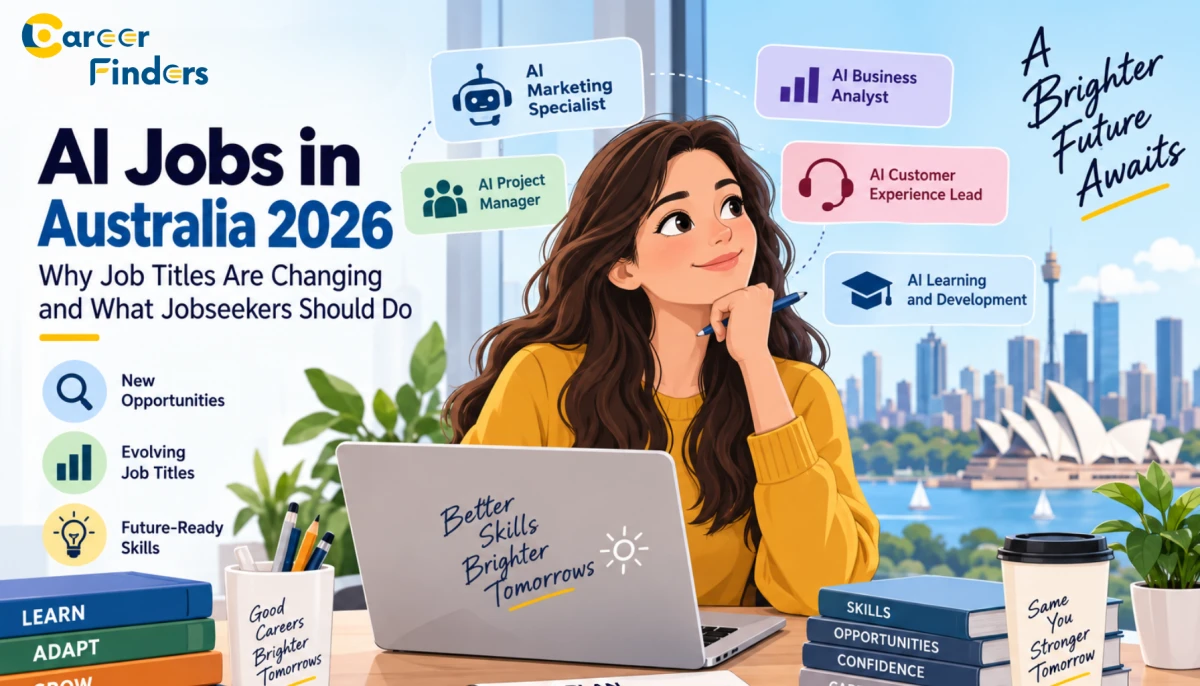
AI Jobs in Australia 2026: Why Job Titles Are Changing and What Jobseekers Should Do
Searching for a job in Australia is starting to look different.You may open a job board and see familiar positions described with unfamiliar titles. A marketing role may suddenly mention AI. A management position may include artificial intelligence in its title or responsibilities. Sales, education, data, customer service and operational roles are also beginning to use new technology-focused language.This does not necessarily mean that every worker now needs to become a programmer or artificial intelligence specialist.Instead, it shows how quickly the Australian workplace is changing.Recent research from Indeed Hiring Lab found that the number of Australian job titles mentioning AI has more than tripled over the past year. In the March quarter of 2026, 71 normalised Australian job titles had enough advertisements mentioning AI to be classified as “AI-touched”.For jobseekers, understanding this change can make it easier to recognise opportunities, search for jobs effectively and prepare for new employer expectations.1. Why Are Australian Job Titles Changing?Job titles have always changed as industries develop.Positions that were common ten or twenty years ago may now have different names because the technology, tools and responsibilities involved have changed.Artificial intelligence is creating another shift.Employers are not only recruiting people whose main job is to develop AI technology. Some businesses are also adding AI responsibilities to existing positions.Indeed's Australian research found that although technology roles still dominate AI-related job titles, the trend is gradually spreading beyond technology. In the March quarter of 2026, 39% of AI-touched job titles were in non-tech occupations.This means a familiar career may continue to exist while the language employers use to describe it changes.For jobseekers, that makes understanding the actual responsibilities of a position more important than simply recognising its title.2. An Unfamiliar Job Title Does Not Always Mean an Unfamiliar CareerImagine you have worked in marketing for several years.You understand campaigns, content, customers, reporting and digital platforms. You then find a vacancy with a title that includes terms such as AI, automation or generative AI.It may initially appear to be a completely different career.But when you read the job description, many of the core responsibilities may still match your experience.The employer might simply expect candidates to use new tools for research, content analysis, reporting, administration or workflow improvement.Indeed's research notes that many roles receiving AI-related titles are jobs that have existed for years. In some cases, employers are adding AI language because the technology has become part of the role rather than because an entirely new profession has been created.So do not automatically reject a vacancy because its title sounds unfamiliar.Read further first.3. Read the Responsibilities Before Judging the TitleJobseekers often search according to exact job titles.That approach can now cause you to miss relevant opportunities.Instead of asking only, “Have I held this exact job title before?”, ask whether you have performed similar responsibilities.Look carefully at what the employer actually wants the person to do.Consider the required skills, software, industry knowledge, communication responsibilities, reporting duties and level of experience.For example, an employer may advertise a position using newer AI terminology while still requiring traditional skills such as problem-solving, communication, project management, stakeholder management or customer understanding.The title attracts attention, but the responsibilities tell you whether you are genuinely suitable.4. You May Need AI Skills Without Becoming an AI ExpertOne of the biggest mistakes jobseekers can make is assuming that AI skills always mean advanced technical knowledge.Some positions will certainly require programming, machine learning, data science or specialist technical expertise.Many others may simply expect employees to understand how to use AI tools appropriately within their normal work.Jobs and Skills Australia has found that generative AI is more likely to augment work rather than simply replace jobs, while digital and AI capability is becoming increasingly important across the workforce.For a non-technical employee, useful AI capability could mean knowing when an AI tool is appropriate, checking its output, protecting confidential information and combining technology with professional judgement.That is very different from building an AI system yourself.5. Search for Skills as Well as Job TitlesAs titles become more varied, job searching should become more flexible.If you only search one exact title, you may see only part of the available market.Suppose you are looking for digital marketing work. Searching only “Digital Marketing Specialist” may exclude positions using terms connected with automation, AI marketing, growth, content technology or digital optimisation.The same issue can affect people working in administration, recruitment, finance, education, sales and other professions.Search using your main skills as well as your preferred job title.You can then compare the responsibilities and determine whether the position matches your background.This approach is particularly useful when employers are experimenting with new language for existing types of work.6. Update Your Resume Without Filling It With AI BuzzwordsSeeing AI mentioned everywhere can tempt candidates to add the word repeatedly to their resume.That is unlikely to help if you cannot explain what you actually did.Instead, describe genuine examples.If you use AI tools to research information, organise ideas, analyse data, create initial drafts, automate repetitive work or improve a workflow, explain the practical outcome.For example, saying that you “used AI” provides very little information.Explaining that you used an AI-assisted workflow to reduce the time required for a repetitive reporting task gives the employer more context.Your resume should still focus on results, responsibilities and evidence.Technology is a tool. Employers ultimately need to understand what you can achieve with it.7. Keep Human Skills VisibleThe rise of AI does not mean traditional workplace skills have stopped mattering.In fact, new technology can make judgement, communication and accountability even more important.An AI system may help generate information quickly, but an employee may still need to decide whether that information is accurate, appropriate and useful.A tool can assist with a draft, but a person remains responsible for understanding the audience and business objective.A system may analyse information, but employees still need to explain the result to colleagues, customers or management.Jobs and Skills Australia has highlighted both digital capability and non-digital capabilities as important as workplaces adapt to generative AI.Therefore, do not remove communication, teamwork, critical thinking or problem-solving from your career story simply because technology is receiving more attention.8. Be Ready to Explain How You Use AIIf AI appears in a job advertisement, there is a reasonable chance the employer will want to understand your experience with it.You do not need to pretend to know every platform.A clear answer about one or two genuine examples is usually more useful than naming many tools without explaining how you used them.Think about a real work, study or project situation.What problem were you trying to solve? Which tool did you use? What part of the process did it assist with? How did you check the output? What was the final result?This demonstrates both technology awareness and professional judgement.It also helps employers understand whether you can use new tools responsibly rather than simply following the latest trend.9. Do Not Let an Impressive Title Distract You From the Actual JobNew job titles can sound exciting.However, candidates should still evaluate positions in the same careful way they would evaluate any other vacancy.Check the responsibilities, experience requirements, employment type, salary information where available, location and expected outcomes.Ask yourself whether the position offers work that actually matches your skills and career direction.An AI-related title does not automatically make a job more advanced or more suitable for your future.The substance of the role matters more than the terminology.10. Keep Learning as Your Industry ChangesAustralian hiring activity has not stopped while workplaces adapt to new technology.Jobs and Skills Australia's August 2026 employer survey found that 50% of surveyed employers had recruitment activity, while 20% expected to increase staffing levels. At the same time, 45% reported recruitment difficulty.That combination shows why skills remain important.Employers are recruiting, but many are also trying to find candidates who match changing requirements.Jobseekers do not need to chase every new trend. However, understanding which tools and skills are becoming relevant to your particular occupation can help you stay competitive.Small, continuous learning is often more practical than waiting until your industry has already changed dramatically.Final ThoughtsArtificial intelligence is not only creating new jobs in Australia. It is also changing the language used to describe existing work.For jobseekers, that means career searching in 2026 requires a slightly broader approach.Do not rely only on familiar job titles. Read the responsibilities, search using skills, understand how technology is affecting your occupation and be prepared to demonstrate practical examples of how you work with new tools.At the same time, do not allow AI terminology to make you underestimate the value of the experience you already have.A job may have a new title while still requiring many of the same core professional skills.The Australian job market will continue to evolve. Candidates who can understand changing job language, continue learning and clearly communicate the value they bring will be better prepared to identify opportunities as they appear.1. Indeed Hiring Lab Australia – Old Jobs, New Buzzword: Job Titles Get an AI MakeoverAustralian employers are increasingly adding AI terminology to job titles across tech and non-tech roles. https://hiringlab.indeed.com/au/blog/2026/09/03/old-jobs-new-buzzword-job-titles-get-an-ai-makeover/2. Jobs and Skills Australia – Australia’s AI Transition: Jobs, Skills and the Future of WorkExplains how generative AI is expected to reshape Australian jobs and mainly augment rather than simply replace human work. https://www.jobsandskills.gov.au/studies/generative-artificial-intelligence-capacity-study3. Jobs and Skills Australia – Our Gen AI Transition: SkillsCovers the growing importance of digital, AI and non-digital skills in Australia's workforce. https://www.jobsandskills.gov.au/studies/generative-artificial-intelligence-capacity-study/our-gen-ai-transition-skills4. Jobs and Skills Australia – Our Gen AI Transition: ExposureExplains how AI may augment or automate different tasks across Australian occupations. https://www.jobsandskills.gov.au/studies/generative-artificial-intelligence-capacity-study/our-gen-ai-transition-exposure5. Jobs and Skills Australia – Our Gen AI Transition: Labour Market DynamismProvides information about AI-related upskilling, reskilling, job mobility and changing occupations. https://www.jobsandskills.gov.au/studies/generative-artificial-intelligence-capacity-study/our-gen-ai-transition-labour-market-dynamism6. Jobs and Skills Australia – Recruitment Experiences and Outlook SurveyProvides current Australian employer recruitment activity, recruitment difficulty and staffing outlook data. https://www.jobsandskills.gov.au/data/recruitment-experiences-and-outlook-survey#AIJobsAustralia #FutureOfWork #AustralianJobs #JobSearchAustralia #CareerTips #AISkills #JobMarket2026 #CareerDevelopment #AustralianCareers #WorkplaceTrends #JobSeekers #CareerGrowth #HiringTrends #DigitalSkills #CareerFinders
 16-Sep-2026


News Insights
How to Explain a Short Job Stay in an Interview Without Hurting Your Chances
A short stay in a previous job can feel difficult to explain during an interview. You may have left because the role was different from what was advertised, the workplace was not suitable, your contract ended, your position was made redundant or personal circumstances changed.Whatever the reason, seeing a role of only a few weeks or months on your resume may make you worry that an employer will question your reliability.The good news is that one short job does not automatically make you a poor candidate. People change jobs for many genuine reasons, and career paths are rarely perfect. What matters is how clearly, professionally and honestly you explain the situation.Here is how to discuss a short job stay without damaging your chances of getting hired.1. Understand Why Employers Ask About Short EmploymentWhen interviewers ask why you left a position quickly, they are usually trying to understand the situation rather than automatically rejecting you.They may want to know whether:You left because of a temporary issue.You had difficulty meeting the role’s expectations.The position or workplace was different from what you expected.You are likely to leave their company quickly as well.You made a careful career decision or acted without planning.Employers invest time and money in recruiting and training new employees. They therefore want some confidence that the person they hire genuinely understands the role and is interested in staying.Your answer should reduce these concerns without becoming defensive.2. Be Honest Without Sharing Every DetailHonesty is important, but an interview does not require you to share every private detail about your previous workplace or personal life.Give a short, truthful explanation and then move the conversation towards what you learned and why the new role suits you better.For example:“The position turned out to be significantly different from the responsibilities discussed during recruitment. I first tried to clarify the expectations with my manager, but it became clear that the role was not the right long-term match. The experience helped me understand the importance of confirming responsibilities early, which is why I have carefully reviewed this opportunity.”This answer explains the situation without criticising the previous employer. It also shows that you attempted to manage the problem professionally before leaving.3. Never Speak Negatively About Your Previous EmployerEven if you had a difficult experience, avoid describing your previous employer, manager or colleagues negatively.Statements such as “my manager was terrible,” “the company was disorganised” or “everyone was difficult to work with” can create concerns about your judgement and professionalism.Instead, use neutral language:The role was not aligned with the original expectations.The position did not offer the required career direction.The workplace structure was not the right professional fit.The role changed following an internal restructure.The work arrangement was no longer suitable.Focus on the mismatch or change in circumstances—not on blaming another person.4. Keep Your Explanation Short and FocusedA common mistake is giving a long explanation because you feel nervous. Too much detail can make the situation sound more serious than it was.A strong response can normally be delivered in three parts:Briefly explain what happened.Mention what you learned.Connect your experience to the position you want now.For example:“I accepted the role because it appeared to match my customer service experience. After starting, I learned that most of the work involved duties outside that area. I completed my responsibilities professionally, but ultimately decided to find a position that better matched my strengths. This opportunity interests me because it focuses directly on customer communication and service.”This structure keeps your answer positive and brings the interviewer’s attention back to your suitability.5. Prepare an Answer for Your Specific SituationYour response should reflect the genuine reason behind the short stay.If the role was different from the advertisement:“The daily responsibilities were substantially different from those discussed during the recruitment process. I gave the position a fair opportunity, but it was not aligned with my experience or long-term direction.”If your contract ended:“It was a short-term contract created to support a specific project. I completed the agreed work, and the position ended when the project finished. I am now looking for a longer-term opportunity.”If your position was made redundant:“The organisation restructured shortly after I joined, and my position was made redundant. The decision was unrelated to my performance, and I am now ready to bring the skills I gained to a new team.”If you left for personal reasons:“I needed to leave because of a personal situation that required my attention. That situation has now been resolved, and I am fully prepared to return to work.”If the role was not suitable:“After starting, I realised the position was not the right match for my skills and career direction. I learned from the experience and have since been more careful when assessing opportunities.”6. Explain What You Learned From the ExperienceA short role can still provide valuable experience. You may have learned a new system, improved your communication, adapted to a different workplace or gained a clearer understanding of your career goals.Think about the positive outcomes before attending your interview.You could mention:A technical or digital skill you developed.Experience working with different customers.Improved teamwork or communication.A stronger understanding of workplace expectations.Greater clarity about your preferred career path.The ability to adapt quickly to change.This helps an employer see that the experience was not wasted, even though it was brief.7. Show Why the New Role Is a Better MatchAfter explaining your short stay, clearly describe why you are interested in the new opportunity.Research the company, responsibilities, working arrangements and required skills before the interview. Identify two or three genuine reasons why the role suits you.You might say:“I have reviewed the position carefully, and it strongly matches my experience in administration and customer support. I am particularly interested in the opportunity to manage client enquiries and develop within a structured team. I am looking for a stable role where I can contribute and grow over time.”This shows that you are not simply applying randomly. You understand the opportunity and have made a more informed decision.8. Be Ready to Discuss Multiple Short JobsOne short role is usually easier to explain than a repeated pattern of brief employment. If your resume contains several short positions, the interviewer may want additional reassurance.Do not avoid the pattern. Acknowledge it and explain the circumstances honestly.Some roles may have been casual, seasonal, temporary or project-based. Clearly label these positions on your resume so employers do not mistake planned short-term work for frequent resignations.If you made several career moves by choice, explain what changed and why you are now seeking stability.For example:“Several of my previous positions were temporary contracts, which allowed me to gain experience across different workplaces. I am now looking for a permanent opportunity where I can use that experience and build longer-term professional relationships.”9. Practise Your Answer Before the InterviewPrepare your explanation in advance and practise saying it aloud. Your answer should sound natural rather than memorised.Ask a friend to listen and tell you whether the response sounds:Honest and clear.Calm rather than defensive.Respectful towards the previous employer.Focused on the future.Relevant to the new position.During the interview, maintain comfortable eye contact, use a steady tone and avoid apologising repeatedly. A short employment period is part of your career history, but it does not define your professional value.10. Turn the Conversation Back to Your StrengthsOnce you have answered the question, guide the discussion towards your skills, achievements and interest in the position.You can say:“Although the role was brief, it strengthened my ability to adapt quickly and communicate with different team members. Those skills would be useful in this position, particularly when supporting customers and managing changing priorities.”This transition reminds the interviewer why you deserve consideration.Final ThoughtsA short job stay does not have to prevent you from securing your next opportunity. Employers understand that contracts end, workplaces restructure, responsibilities change and personal circumstances sometimes affect employment.The strongest approach is to be truthful, concise and professional. Explain what happened without criticising anyone, show what you learned and demonstrate why the new opportunity is a better fit.Prepare your answer before the interview, but do not allow one short role to reduce your confidence. Your complete experience, skills, attitude and potential matter far more than a single date on your resume.CareerFinders.co helps jobseekers across Australia and New Zealand explore suitable opportunities and access practical career guidance for every stage of the hiring process.Sources and References1. Australian Bureau of Statistics – Job mobility data provides information about Australians changing or leaving jobs.https://www.abs.gov.au/statistics/labour/jobs/job-mobility/latest-release2. Fair Work Ombudsman – Official information about probation periods in Australian workplaces.https://www.fairwork.gov.au/starting-employment/probation3. Fair Work Ombudsman – Guidance about resignation, notice and ending employment correctly.https://www.fairwork.gov.au/ending-employment/resignation4. Jobs and Skills Australia – Labour-market and career information for Australian workers and jobseekers.https://www.jobsandskills.gov.au/data5. Workforce Australia – Job-search guidance, employment services and support for Australian jobseekers.https://www.workforceaustralia.gov.au/individuals/coaching6. Australian Human Rights Commission – Guidance on preventing discrimination during recruitment.https://humanrights.gov.au/our-work/employers/step-step-guide-preventing-discrimination-recruitment7. Career Industry Council of Australia – Career development information and Australian career resources.https://cica.org.au/australian-jobs/#CareerFinders #JobInterviewTips #AustralianJobs #JobSearchAustralia #CareerAdvice #InterviewPreparation #Jobseekers #EmploymentAustralia #CareerGrowth #ResumeTips #HiringTips #CareerDevelopment #InterviewAnswers #WorkplaceAdvice #AustralianCareers
15-Sep-2026

News Insights
How to Prepare for a Work Sample Test During the Australian Hiring Process
Australian employers are increasingly using work sample tests to understand what candidates can actually do. A strong resume may help you reach the next stage, but a practical task gives the employer direct evidence of your skills, judgement and working style.A work sample test can feel stressful, especially when you do not know what to expect. However, it is also an opportunity. Instead of relying only on interview answers, you can demonstrate how you approach a realistic workplace problem.This guide explains what work sample tests are, why employers use them and how you can prepare confidently during the Australian hiring process.1. Understand What a Work Sample Test IsA work sample test is a practical activity designed to reflect tasks from the advertised position. It may be completed online, at the employer’s workplace or during an assessment centre.The format depends on the role. For example:A writer may prepare a short article.A designer may create a simple visual concept.An administrator may organise information in a spreadsheet.A customer service candidate may respond to a difficult enquiry.A developer may complete a coding task.A manager may analyse a business problem and present recommendations.The employer is usually checking more than the final answer. They may also consider how you organise information, follow instructions, manage time and explain your decisions.2. Read Every Instruction CarefullyMany candidates begin too quickly because they want to finish before the deadline. This can lead to avoidable mistakes. Read the complete brief before starting and highlight the important requirements.Check the required format, word limit, deadline, audience and submission method. Identify whether you need to use particular software, provide sources or explain your process.Create a simple checklist and review it before submitting. A strong answer that ignores one important requirement may still receive a low assessment.3. Research the Role and EmployerYour work sample should match the position rather than showing every skill you have. Read the job advertisement again and identify the main duties, required abilities and common words.Then review the employer’s website, services, customers and communication style. A marketing task for a professional services firm should not look like a campaign for a casual entertainment brand.Do not copy the company’s existing material. Use your research to understand its audience and priorities. Your goal is to produce original work that feels relevant to the organisation.Also research normal standards in the industry. This can help you choose an appropriate tone, structure and level of detail.4. Practise Similar Tasks Before the TestPreparation becomes easier when you practise the type of work you may receive. Use the job duties to create small exercises for yourself.If the position involves reports, practise turning information into a clear one-page summary. If it involves customer service, write responses to common complaints. If it requires presentations, practise explaining a recommendation within five minutes.Set a realistic time limit while practising. This will show whether you spend too long planning, writing or checking. You can then improve your process before the real assessment.Do not memorise one perfect answer. Employers can change the scenario. Practise a repeatable method that helps you understand the problem, plan your response, complete the task and review the result.5. Plan Before You StartWhen the test begins, avoid immediately creating the final answer. Spend a few minutes breaking the task into smaller steps.A simple plan may include:Confirm the objective.Identify the intended audience.List the main requirements.Decide the order of your response.Reserve time for checking.Planning reduces the risk of reaching the deadline with an unfinished answer. It also helps you focus on the employer’s problem instead of adding unnecessary information.If the task has several parts, estimate how much time each part deserves. Give more attention to sections that carry greater importance, but make sure you answer every required question.6. Focus on Quality and AccuracyA work sample represents the standard of work you may produce after being hired. Check spelling, grammar, calculations, formatting and factual accuracy.Use a clean layout with clear headings and consistent spacing. Complicated design is unnecessary unless visual creativity is part of the role. The content should remain easy to understand.Test files before sending them. Confirm that links work, attachments open and the employer can access the document without requesting permission.Do not add skills, data or results that are not true. A simple and accurate response is stronger than an impressive-looking answer built on false information.7. Use AI Tools ResponsiblyEmployers may have rules about using artificial intelligence during assessments. Read the instructions carefully. If AI tools are prohibited, do not use them.When they are allowed, use them only as support. You remain responsible for checking facts, protecting confidential information and ensuring the final response reflects your own judgement.Never upload private company information, candidate data or confidential documents into an unapproved tool. Do not submit raw AI-generated content without reviewing and rewriting it.If the employer asks how the work was produced, answer honestly. Responsible tool use can demonstrate digital ability, but hiding prohibited use can damage trust and end your application.8. Review and Submit ProfessionallyLeave enough time for a final review. Compare your work with the original instructions one requirement at a time.Check:Have you answered every part?Is the response within the stated limit?Are names and figures correct?Is the file named professionally?Have you used the requested format?Submit before the deadline when possible. Use a short message confirming that the task is attached and thanking the employer for the opportunity.After submission, prepare to discuss your work. The interviewer may ask what you found difficult, what you would improve or why you chose a particular approach. Review your decisions so you can answer naturally.Common Mistakes to AvoidCandidates often lose marks because they rush, ignore the audience or submit without checking. Other common problems include copying online examples, using too much jargon, missing the deadline and producing more work than requested.Avoid trying to guess a hidden “perfect” answer. Follow the brief, demonstrate relevant skills and communicate your reasoning clearly. If you make an assumption, state it.Final ThoughtsA work sample test is not only another obstacle in the Australian hiring process. It is your opportunity to move beyond claims on a resume and provide clear evidence of your ability.Prepare by studying the role, researching the employer and practising realistic tasks. During the assessment, read carefully, plan your time, follow every instruction and check your work.Stay honest about your skills and any tools you use. Protect confidential information and be cautious about requests for excessive unpaid work.You do not need to create the most complicated response. A clear, accurate and practical submission that solves the stated problem can make a stronger impression. With preparation and a calm approach, your work sample can help an Australian employer see how you could contribute from your first day.Sources and References1. Differentiated Recruitment – Australian Public Service CommissionThis source explains how employers can assess candidates through different methods, including work sample tests and written responses.https://www.apsc.gov.au/working-aps/hr-practitioners/recruitment-aps/recruiting/planning-recruitment-process/factsheet-differentiated-recruitment2. Merit-Based Recruitment Decisions – Australian Public Service CommissionThis source explains how assessment methods should measure the skills and qualities genuinely required for a position.https://www.apsc.gov.au/working-aps/hr-practitioners/recruitment-aps/recruiting/selection-panels/factsheet-merit-based-decisions-selection-panels3. Planning the Recruitment Process – Australian Public Service CommissionThis page provides information about assessment methods and the planning of fair recruitment processes.https://www.apsc.gov.au/working-aps/hr-practitioners/recruitment-aps/recruiting/planning-recruitment-process4. Managing Candidate Use of AI in Recruitment – Australian Public Service CommissionThis guide explains how AI use can be managed during recruitment while maintaining fair and effective assessments.https://www.apsc.gov.au/sites/default/files/2026-04/Guide%20for%20managing%20candidate%20use%20of%20AI%20in%20recruitment_accessible.pdf5. Unpaid Work Trials – Fair Work OmbudsmanThis source explains when an unpaid skills demonstration may be reasonable and when the work must be paid.https://www.fairwork.gov.au/starting-employment/unpaid-work/unpaid-trials6. Unpaid Work Fact Sheet – Fair Work OmbudsmanThis fact sheet provides information about unpaid trials, internships, workplace placements and employee payment rights.https://www.fairwork.gov.au/tools-and-resources/fact-sheets/unpaid-work/unpaid-work-unpaid-work7. Preventing Discrimination in Recruitment – Australian Human Rights CommissionThis guide explains how Australian employers can maintain fair and non-discriminatory recruitment practices.https://humanrights.gov.au/our-work/employers/step-step-guide-preventing-discrimination-recruitment#WorkSampleTest #AustralianHiringProcess #JobsInAustralia #AustralianJobs #JobInterviewTips #HiringAssessment #CareerFinders #JobSearchAustralia #CareerAdvice #Jobseekers #RecruitmentAustralia #InterviewPreparation #EmploymentTips #CareerGrowth #WorkplaceSkills
14-Sep-2026

News Insights
AI Is Becoming a Job Interview Skill in 2026: How to Answer “How Do You Use AI at Work?”
Artificial intelligence is no longer only changing how people search for jobs. It is also changing what employers ask candidates during interviews.A few years ago, questions about AI were mainly expected in technology, data or software roles. In 2026, that is changing.Candidates in marketing, administration, finance, customer service, recruitment, operations, management and many other professions may now be asked questions such as:How do you use AI in your work?Which AI tools have you used?Can you give an example of AI improving your productivity?How do you check whether AI-generated information is correct?What tasks would you never leave completely to AI?For job seekers, this creates a new interview challenge.You do not need to present yourself as an AI expert. However, being able to explain how you use modern tools responsibly may help demonstrate adaptability, problem-solving and willingness to learn.1. Why AI Is Becoming an Interview TopicAI is becoming part of everyday workplace technology.Jobs and Skills Australia says digital and AI capability is increasingly important, while skills such as critical thinking, problem-solving and responsible use remain essential alongside technology.This means many employers are not simply looking for someone who knows the name of an AI tool.They want to understand whether a candidate can use technology to improve their work without losing human judgement.Recent reporting also shows job seekers are increasingly preparing to discuss their use of AI during interviews because employers want practical examples rather than general statements about being “interested in AI.”The important question is therefore not:“Do you use AI?”It is:“Can you use AI appropriately and still take responsibility for your work?”2. What Employers Actually Want to HearImagine an interviewer asks:“How have you used AI in your previous work?”A weak answer might be:“I use ChatGPT all the time.”That tells the employer almost nothing.A stronger answer explains the situation, the task, the tool and the result.For example:“I sometimes use AI to create an initial structure for reports. I then verify the information, rewrite the content for the intended audience and complete the final review myself. It helps me begin routine work faster while keeping responsibility for the final output.”The second answer shows several useful qualities:Practical AI experienceHuman oversightCritical thinkingCommunication skillsResponsibility for accuracyEmployers generally care more about this thinking process than whether you know dozens of different AI platforms.3. Use the Problem → AI → Review → Result MethodA simple way to prepare your answer is to use four steps.ProblemExplain what you needed to complete or improve.AIExplain how an AI tool assisted you.ReviewExplain what you personally checked, changed or verified.ResultExplain what improved.For example, a marketing candidate might say:“I needed to develop several campaign ideas for a new service. I used generative AI to brainstorm different angles, then compared those ideas with our target audience and brand guidelines. I selected and rewrote the strongest concepts myself. It reduced the initial brainstorming time and gave the team more options to discuss.”The AI tool is only one part of the story.The candidate remains responsible for the decision.4. Give Examples Relevant to Your ProfessionYou do not need a highly technical AI project.A simple example related to your profession can be stronger.AdministrationYou may explain how AI helped organise notes, create an initial document structure or summarise non-confidential information.MarketingYou might use AI for brainstorming, content ideas, research organisation or variations of campaign messaging.Customer ServiceAI might help identify common customer questions or organise information, while a person still handles complex conversations.RecruitmentAI may assist with organising information or administrative tasks, but candidate evaluation should still involve appropriate human judgement.Data and TechnologyCandidates may discuss coding assistance, documentation, data analysis, testing or technical research while explaining how outputs were validated.The goal is not to make AI sound impressive.The goal is to demonstrate that you know where AI adds value and where human judgement remains necessary.Jobs and Skills Australia has found that AI-related skills are particularly visible in technical occupations, although AI capability is extending beyond purely technical positions.5. Avoid Exaggerating Your AI ExperienceOne mistake candidates can make is pretending to have advanced AI experience because they believe employers expect it.That approach can easily create problems.An interviewer may ask:“Which project did you use it for?”“How did you check the output?”“What limitations did you find?”“How did you measure the result?”If your original claim was exaggerated, the follow-up questions can expose it quickly.It is completely acceptable to say that you are still developing your skills.For example:“I have mainly used generative AI for research organisation and initial drafting so far. I am still learning more advanced applications, but I always review the results carefully rather than using them automatically.”That answer can demonstrate honesty and a learning mindset.6. Show That You Understand AI’s LimitationsKnowing how not to use AI can be just as important as knowing how to use it.AI-generated content can sometimes be incomplete, inaccurate or inappropriate for a particular situation.Candidates should therefore be comfortable discussing issues such as:AccuracyConfidential informationPrivacyBiasCopyrightCompany policiesHuman reviewFor example, uploading confidential customer data, internal company documents or sensitive personal information into an unapproved public AI service could create serious problems.A strong candidate understands that convenience does not remove professional responsibility.Australia’s national work on generative AI similarly emphasises confident, critical and responsible use of digital technologies rather than simply increasing AI adoption.7. Do Not Let AI Replace Your PersonalityAI is also changing job applications themselves.Recruiters have reported that widespread AI use can make resumes and applications begin to sound very similar.This creates an interesting situation.AI can help you prepare.But your interview still needs to sound like you.Avoid memorising a perfect AI-generated response word for word.Instead, prepare real examples from your own:Work experienceUniversity projectsInternshipsVolunteeringFreelance workPersonal projectsThen practise explaining those examples naturally.Human connections and personal credibility may actually become more valuable as AI makes applications easier to produce at scale. The World Economic Forum recently highlighted renewed importance around referrals and human connections as employers try to distinguish candidates in an AI-heavy recruitment environment.8. Prepare These Five AI Interview QuestionsBefore your next interview, practise answering:1. How do you currently use AI in your work or study?Give one real example.2. Which AI tools have you used?Mention only tools you genuinely understand.3. How do you check AI-generated information?Explain your verification process.4. Which tasks should still require human judgement?Choose examples relevant to your profession.5. How would you learn a new AI tool introduced by our company?Show curiosity and adaptability.You do not need complicated answers.Clear, specific examples are usually more convincing than technical buzzwords.Final ThoughtsAI may become one of the defining workplace skills of the next few years, but successful candidates will need more than the ability to type prompts.Employers still need people who can understand problems, communicate clearly, check information, make decisions and take responsibility for results.The strongest interview message is therefore not:“AI can do my job.”It is:“I know how to use AI to help me do my job better.”Before your next interview, identify one genuine example where technology helped you work more efficiently. Explain what you did, what AI contributed, what you personally reviewed and what result you achieved.That single example could give you a much stronger answer when the AI question appears in your next interview.Sources & References(1) Job seekers are increasingly being expected to explain how they use AI during interviews, making AI fluency a new part of interview preparation.Business Insider — Job seekers are learning a new interview skill: how to sound excited about AI(2) Jobs and Skills Australia says workers need digital and AI capability alongside critical thinking and responsible technology use.Jobs and Skills Australia — Our Gen AI Transition: Skills(3) Australian research indicates generative AI is more likely to augment human work than simply replace it.Jobs and Skills Australia — Australia's AI Transition(4) Australian recruiters say AI is changing recruitment and making many applications increasingly similar.ABC News — CVs losing value as AI changes recruitment(5) Human connections and referrals are becoming more important as AI makes job applications easier to create at scale.World Economic Forum — Human connections and hiring in the age of AI(6) Current workplace developments show major employers are integrating AI into everyday operations while retraining employees for AI-supported work.Reuters — Wipro's AI push and workforce transformation#AIJobs #JobInterview #AISkills #CareerFinders #JobSearchAustralia #InterviewTips #CareerAdvice #FutureOfWork #AustralianJobs #JobSeekers #GenerativeAI #HiringTrends #CareerGrowth #WorkplaceSkills #Jobs2026
11-Sep-2026

News Insights
Career Cushioning in Australia: 7 Smart Ways to Build a Career Plan B in 2026
You may be happy in your current job.You may like your team, have a stable salary and have no immediate plan to resign.But what would happen if your role suddenly changed, your company restructured, your industry slowed down or a better opportunity appeared?This is where a growing career trend called career cushioning comes in.Career cushioning means preparing a professional backup plan while you are still employed. It does not necessarily mean secretly planning to resign. Instead, it means keeping your skills, resume, professional network and understanding of the job market ready so you are not starting from zero when circumstances change.In a changing Australian employment market, career security increasingly depends not only on keeping your current job but also on remaining employable.Recent research suggests Australian workers are becoming more willing to explore opportunities. Gartner reported that 26.5% of Australian employees were actively seeking a new role in the second quarter of 2026, up from 19.4% in the final quarter of 2025.So how can you build a career cushion without turning your working life into a permanent job search?1. Keep Your Resume Ready Before You Need ItMany people update their resume only after they decide to leave a job.That creates unnecessary pressure.Six months or two years may have passed since the resume was last updated, making it difficult to remember achievements, projects, responsibilities and results.Instead, review your resume every few months.Add major achievements while they are still fresh. Record new responsibilities, software, certifications, projects and measurable results.For example, rather than simply writing:“Responsible for customer enquiries.”A stronger achievement could be:“Managed high-volume customer enquiries while helping improve response times and service quality.”Your resume does not need to be sent anywhere today.It simply needs to be ready when the right opportunity appears.2. Build Skills Before the Market Forces You ToOne of the strongest forms of career security is having skills that employers continue to value.That does not mean collecting random certificates.Look at jobs similar to yours and identify skills that repeatedly appear in advertisements.You might notice employers asking for:AI and digital toolsData analysisCustomer relationship management systemsProject coordinationLeadershipCommunicationIndustry-specific softwareChoose one or two skills that could improve your options and start developing them while you are employed.The objective is not to prepare for every possible future job.It is to make sure your skills continue moving forward even when your job title stays the same.3. Know What Your Skills Are Worth in the MarketCareer cushioning is difficult if you have no idea what employers currently want.Spend some time checking positions related to your work.Look at salaries, required experience, qualifications, locations and frequently requested skills.You may discover that your experience can qualify you for jobs with different titles.You may also discover gaps that should be addressed before your next career move.Australia still has significant recruitment activity. Jobs and Skills Australia reported 212,200 online job advertisements in July 2026, an increase of 2.7% from the previous month and around 25% above the monthly average recorded in 2019.The point is not to apply to every opening you see.Use job advertisements as career research.They can tell you what employers may expect from you six months or two years from now.4. Maintain Your Professional NetworkA network should not suddenly appear when you lose a job.Stay connected with former colleagues, managers, classmates, clients, recruiters and people working in your industry.You do not need to message everyone asking for work.Professional networking can be simple.Congratulate someone on a promotion. Comment thoughtfully on an industry discussion. Reconnect with an old colleague. Attend an industry event. Follow organisations that interest you.These small interactions keep professional relationships active.Then, if circumstances change, you already have people who know your experience rather than having to introduce yourself to an entirely new network during a stressful job search.5. Keep Your Online Professional Profile CurrentYour resume is only one part of your professional identity.Your online profile should also reflect where your career is today.Update your job title, skills, responsibilities and professional summary when something important changes.Your profile should make it easy to understand:What do you do?What are you good at?What industries do you understand?What type of problems can you solve?Avoid making your profile look like an announcement that you are desperate to leave your employer.Career cushioning is about professional readiness, not broadcasting dissatisfaction.A clear and current professional profile simply gives recruiters and industry contacts a better understanding of your capabilities.6. Understand Why You Might Eventually LeaveBuilding a backup plan is easier when you understand what you actually want.Ask yourself what would make you consider another opportunity.Would you move for better pay?Career progression?Flexible work?A stronger manager?More interesting responsibilities?A shorter commute?Greater stability?These issues matter to Australian workers. Gartner's latest Australian survey found factors such as location, compensation, respect, work-life balance, manager quality and future career opportunities influencing attraction and retention decisions.Hays also reported in its FY26/27 Salary Guide that 50% of surveyed Australian professionals felt underpaid, while only 42% were satisfied or very satisfied with their salary.Knowing what matters to you makes it easier to distinguish a genuinely better opportunity from a vacancy that simply looks different.7. Do Not Wait for a Crisis to Start PlanningThe biggest advantage of career cushioning is time.You can improve your resume calmly.You can learn skills gradually.You can research employers without pressure.You can build relationships naturally.And you can decide whether an opportunity is actually right for you instead of accepting the first position available because you urgently need work.Australia's job mobility rate was 7.2% in the year ending February 2026, with around one million people changing jobs. The ABS also recorded about 2.1 million people who left or lost a job during the year.Careers change.Companies change.Technology changes.Personal priorities change.Preparing for those possibilities is different from assuming something bad will happen.Career Cushioning Does Not Mean You Have to QuitThere is an important difference between preparing for opportunities and constantly searching for an escape.You can remain committed to your current employer while continuing to develop professionally.In fact, building new skills, improving your network and understanding your industry can make you more valuable in your existing position.Your career cushion may eventually help you find another job.Or it may help you negotiate a promotion, move into a new internal role, recognise your market value or simply feel more confident about your professional future.The objective is optionality.You want to know that if your circumstances change, you have choices.Final ThoughtsA strong career should not depend entirely on one employer, one job title or one skill.In 2026, career resilience means continuing to learn, maintaining professional relationships, understanding the employment market and being prepared for change.You do not need to resign.You do not need to send dozens of applications.Start smaller.Update your resume.Identify one skill to improve.Reconnect with someone in your professional network.Explore positions related to your experience.And ask yourself one simple question:If I needed a new opportunity six months from now, would I be ready?If the answer is no, now may be the best time to start building your career cushion.CareerFinders.co helps job seekers explore opportunities across Australia and New Zealand, understand employment trends and prepare for the next stage of their career.Sources & References(1) Gartner – Australian employees are becoming more confident about job opportunities, with 26.5% actively searching for a new role in Q2 2026. https://www.gartner.com/en/newsroom/press-releases/2026-09-07-gartner-hr-survey-reveals-australian-employees-are-slowly-regaining-confidence-in-the-job-market(2) Jobs and Skills Australia – Online job advertisements reached 212,200 in July 2026, showing continued demand across the Australian labour market. https://www.jobsandskills.gov.au/data/internet-vacancy-index(3) Australian Bureau of Statistics – Australia's job mobility rate was 7.2%, with around 1 million people changing jobs during the year ending February 2026. https://www.abs.gov.au/statistics/labour/jobs/job-mobility/latest-release(4) Hays Australia – 50% of surveyed Australian professionals felt underpaid, while only 42% were satisfied or very satisfied with their salary. https://www.hays.com.au/press-release/content/hays-salary-guide-fy26-27(5) ABS – Participation, Job Search and Mobility – 1.7 million people were not working but wanted work, providing broader context on job searching and career mobility in Australia. https://www.abs.gov.au/statistics/labour/employment-and-unemployment/participation-job-search-and-mobility-australia/feb-2026#CareerCushioning #CareerAdvice #CareerGrowth #JobSearchAustralia #AustralianJobs #CareerPlanning #CareerDevelopment #JobSeekers #FutureOfWork #WorkplaceTrends #ProfessionalGrowth #CareerTips #EmploymentAustralia #JobMarket2026 #CareerFinders
10-Sep-2026

News Insights
Payday Super Is Now in Effect: What Australian Workers Should Check in 2026
Your payslip says your employer has contributed to your superannuation. But when you log in to your super fund, the money is not there. Is that normal, or should you be concerned?For years, many Australian workers experienced a delay between receiving their wages and seeing employer super contributions arrive in their retirement account. That system has now changed.From 1 July 2026, Payday Super requires employers to pay superannuation at the same time as employees’ wages, rather than relying on the previous quarterly payment cycle. The reform is intended to make contributions more timely, easier to track and less likely to go unpaid.Whether you are starting your first job, working casually, changing employers or managing a team, understanding the new rules can help you identify problems early and make more informed decisions about your employment.1. What Is Payday Super and What Changed?Payday Super is a change to the timing of compulsory employer superannuation contributions in Australia.Before the reform, employers generally had to make super guarantee contributions at least quarterly. Some employers chose to pay more frequently, but many workers did not see contributions arrive in their fund until weeks or months after their wages were paid.Under the new rules, employers must make contributions when they pay salary or wages. In most cases, the payment must reach the employee’s nominated super fund within seven business days after payday. There are exceptions and extended timeframes for certain circumstances.For example, if you receive wages every fortnight, your employer is now generally required to make the related super contribution each fortnight as well.The important distinction is that paying super on payday does not necessarily mean the money will appear in your fund account instantly. Payment processing, fund allocation and the applicable deadline still matter.2. Does Payday Super Increase Your Superannuation Rate?Payday Super does not itself increase the compulsory super guarantee percentage. The standard rate remains 12% for eligible employees.However, the reform changes the earnings base used to calculate the guarantee. Employers now calculate super on qualifying earnings, which includes ordinary time earnings and certain additional payments, such as commissions and salary sacrifice amounts. Individual circumstances and special rules can affect the calculation.As a simple illustration, if an eligible employee receives $2,000 in qualifying earnings for a pay period, a 12% contribution would be $240, assuming no special adjustments apply.The reform is not a promise of an automatic increase in take-home pay or an additional bonus. Its central purpose is to ensure compulsory super is calculated and paid more regularly.Workers should check their employment contract, applicable award or enterprise agreement when determining how salary and superannuation are structured.3. Who Is Entitled to Super in Australia?The super guarantee generally applies to employees aged 18 or over, as well as employees under 18 who work more than 30 hours a week.Eligible full-time, part-time and casual employees can receive compulsory superannuation. Some independent contractors who are paid mainly for their labour may also be entitled to super, and temporary residents can be eligible.This means a casual worker should not assume that flexible hours automatically remove their super entitlement. Likewise, being paid through an invoice does not always mean a worker is outside the super guarantee system.Eligibility depends on the actual working arrangement and relevant rules, not simply the job title used by an employer.If you are unsure whether you should receive super, check the Australian Taxation Office guidance or seek advice from a qualified professional.4. How to Check Whether Your Super Has Been PaidThe easiest way to protect your retirement savings is to compare your wage records with the contributions received by your super fund.Follow these practical steps:Check your payslip: Review your gross earnings, superannuation amount and the pay period. Remember that an amount shown on a payslip does not prove the money has reached your fund.Log in to your super fund: Use your fund’s website or app to review recent employer contributions and the dates they were received.Confirm your fund details: Make sure your employer has the correct fund, membership number and personal details, especially after changing jobs or super funds.Compare payments over time: Keep a record of pay dates and the corresponding contributions. This makes it easier to identify a missing or unusually low payment.Ask payroll if something looks wrong: Request confirmation of the contribution amount, payment date and destination fund.You can also use myGov linked to the ATO to view information about your super accounts. Your fund’s own transaction records are particularly useful when checking whether a specific payment has arrived.5. What Should You Do If Your Super Is Missing?A missing contribution should be investigated, but it is important to check the relevant timeframe before assuming your employer has breached the rules.In most ordinary cases, contributions must reach the fund within seven business days of payday. However, the first contribution for a new employee, and certain other situations such as a change of fund, can have an extended timeframe of up to 20 business days.If a payment appears late, start by contacting your employer or payroll team. Ask when the contribution was made, how much was paid and whether there was a rejected payment or incorrect fund information.If the issue continues, you can report unpaid superannuation to the ATO. The ATO has the authority to investigate and recover unpaid compulsory super.Keep copies of payslips, employment agreements, super statements and relevant correspondence. These records can help establish what you were paid, what contributions were expected and what actually reached your fund.Do not wait indefinitely simply because your payslip lists a super amount. The fund transaction is the important confirmation.6. What Employers Need to ReviewFor employers, Payday Super is more than a payroll scheduling change. It requires reliable systems, accurate employee records and sufficient cash flow to meet super obligations every pay cycle.Businesses should ensure their payroll software is configured for qualifying earnings, super guarantee calculations and the required reporting. They should also confirm that their payment provider or clearing house can process contributions within the required timeframe.The ATO’s Small Business Superannuation Clearing House permanently closed on 1 July 2026, so employers who previously used it must have an alternative compliant payment arrangement.Employers should also review onboarding processes to collect accurate super fund details, monitor rejected contributions and correct errors promptly.The ATO has introduced a first-year compliance approach that recognises genuine efforts to meet the new requirements. However, this does not remove the obligation to pay super correctly or mean employers can ignore missing contributions.Clear communication with employees is valuable. Workers should know where to find their super details, how to raise a concern and who to contact if a payment does not appear.Why This Matters for Your CareerSuperannuation may not feel like an immediate priority when you are focused on finding a job, negotiating salary or paying everyday expenses. However, it is an important part of your total employment package.When comparing job offers, look beyond the advertised salary. Confirm whether the salary is inclusive or exclusive of super, understand your employment type and review the relevant contract terms.For workers changing jobs, checking super contributions is also a useful part of the transition. Make sure your new employer has the correct fund details and that contributions from your previous employer have been received.Payday Super makes it easier to monitor payments more frequently, but employees still need to remain informed. A few minutes reviewing your fund account can help you identify a problem before it becomes a long-term issue.The key takeaway: From July 2026, compulsory super is generally paid each payday. Check your fund regularly, understand the applicable deadlines and ask questions when contributions are missing. Your super is part of your employment entitlements, and knowing how it works is an important step toward protecting your financial future.Sources and ReferencesThe following official sources support the article. The links are direct and clickable.(1) The Fair Work Ombudsman explains the Payday Super commencement date, payment timing and exceptions for new employees.https://www.fairwork.gov.au/newsroom/news/payday-super-new-rules-starting-1-july-2026 (2) Moneysmart explains what Payday Super means for employees, how to check contributions and what to do when payments are missing.https://moneysmart.gov.au/how-super-works/what-is-payday-super (3) The Fair Work Ombudsman confirms the 12% super guarantee rate and the general eligibility rules for different types of workers.https://www.fairwork.gov.au/pay-and-wages/tax-and-superannuation (4) The ATO explains qualifying earnings, payment deadlines, payroll reporting and system changes under Payday Super.https://softwaredevelopers.ato.gov.au/PaydaySuper (5) The ATO provides guidance on the first-year compliance approach, rejected contributions and the closure of the Small Business Superannuation Clearing House.https://community.ato.gov.au/s/article/a07Mo00001qD2iH/payday-super-has-started-heres-what-employers-need-to-know-and-do (6) The Australian Government’s business guidance explains the practical payroll, cash-flow and record-keeping preparation required for Payday Super.https://business.gov.au/news/are-you-ready-for-payday-super #PaydaySuper #Superannuation #AustralianWorkers #EmployeeRights #CareerFinders #WorkplaceNews #AustraliaJobs #CareerAdvice #FinancialWellbeing #Jobseekers
09-Sep-2026

News Insights
Australian Workers Are Regaining Job Confidence: What the Latest 2026 Research Means for Your Career
Australia’s job market is sending an interesting signal. After a period of uncertainty, employees are becoming slightly more confident about finding work, but that does not mean every job search is becoming easier. Hiring conditions remain uneven, and changes in technology, business costs and employer expectations are creating different experiences across industries.For jobseekers, the important question is no longer simply, “Are companies hiring?” It is, “Where are opportunities emerging, what are employers looking for, and how can I make a career decision without taking unnecessary risks?”New research released this week provides a useful starting point. It also highlights why workers should pay attention to both economic trends and their own career readiness before deciding whether to stay, apply for a new role or explore a different direction.1. What the Latest Australian Job Confidence Research SaysOn 7 September 2026, Gartner released findings from its Global Talent Monitor survey of 820 Australian employees, conducted between April and June 2026. The research found that job availability confidence increased to 56.3 in the second quarter, compared with 55.7 at the end of 2025, when it had reached a three-year low.Confidence in the overall business environment also improved, reaching 48.8 in the second quarter of 2026, compared with 47.4 in the final quarter of 2025. Gartner described the results as a modest recovery in labour-market sentiment.These figures are confidence index scores, not percentages of people who have found jobs. They indicate that employees are feeling somewhat more positive about opportunities, rather than proving that hiring has suddenly accelerated everywhere.That distinction matters. A worker may feel more comfortable exploring the market while still facing competition, lengthy recruitment processes or limited vacancies in a particular occupation. Likewise, an employer may be more optimistic about business conditions without immediately increasing headcount.The main takeaway is that confidence is improving from a cautious starting point, but candidates still need a well-planned approach.2. Why Job Confidence and Hiring Conditions Can Tell Different StoriesA national employment trend does not describe every profession equally. A person working in hospitality, healthcare, construction or professional services may experience a very different market from someone seeking an entry-level office position.Recent research from Deloitte Access Economics adds another dimension. Its August 2026 Employment Forecasts identified 82 occupations that could face weaker employment demand as AI changes the tasks businesses need workers to perform. The analysis suggested that white-collar roles and some early-career positions may be particularly exposed, while also making clear that AI has not yet caused structural change across Australian employment.The Australian Government’s July 2026 report on AI and employment reached a similarly cautious conclusion. It found no evidence of broad AI-driven labour-market upheaval to date, although some occupations with greater automation exposure had experienced slower employment growth. The evidence was described as suggestive rather than definitive.For jobseekers, this means two things can be true at once: the overall market can remain resilient, and particular roles can become more competitive or change substantially.Instead of relying on a single headline, consider the conditions affecting your specific occupation, location and experience level.3. Should You Change Jobs When Confidence Is Improving?Improving market confidence can make it tempting to leave an unsatisfying role immediately. However, a better job market does not automatically mean a better personal career decision.Before resigning, compare your current position with the opportunities realistically available to you. Consider your salary, career progression, workplace culture, flexibility, job security and the skills you are developing. A higher-paying opportunity may be attractive, but it is important to understand the complete employment arrangement.If you are currently employed, you can often explore the market while maintaining financial stability. Update your resume, research employers and attend interviews before making a final decision. Avoid assuming that an informal conversation or positive interview guarantees an offer.A practical career review should answer:What specifically do I want to improve in my next role?Which skills or achievements make me competitive?What salary and working conditions would justify a move?How many suitable opportunities are available in my location?What would I do if the recruitment process takes longer than expected?The purpose is not to discourage career changes. It is to ensure that your next move is based on evidence and personal priorities rather than a temporary shift in market sentiment.4. What Jobseekers Should Focus on During the Rest of 2026The strongest response to an uncertain market is to improve the quality of your job search rather than simply increasing the number of applications.Research the demand for your occupation. Look at recent vacancies, required qualifications, salary ranges and the types of employers advertising. Compare several roles rather than relying on one job advertisement. This can help you identify whether your current skills match the market or whether a particular requirement is becoming more common.Build evidence of your abilities. Employers need to understand what you can actually contribute. Prepare examples of projects, customer outcomes, operational improvements, technical work or measurable achievements. If you have limited professional experience, relevant coursework, volunteering and practical projects can still demonstrate capability.Develop skills relevant to your profession. AI literacy may be useful in many roles, but it should not be treated as a replacement for industry knowledge. PwC’s June 2026 AI Jobs Barometer reported that Australian job advertisements requiring AI skills increased from around 20,000 in 2024 to 41,000 in 2025. The broader message is that employers increasingly value people who can combine modern tools with professional expertise and human judgement.Apply selectively and prepare properly. Prioritise positions that fit your experience and career goals. Tailor your application to the role, prepare clear examples for interviews and keep a record of your progress. A smaller number of thoughtful applications may provide better learning and feedback than an unfocused search.5. What Employers Should Learn From Improving Employee ConfidenceGreater confidence can also change employee behaviour. When workers believe more opportunities are available, they may be more willing to explore alternatives, compare salaries or reconsider whether their current workplace supports their long-term goals.Employers should not interpret this as a reason to panic or assume that employees are about to resign. Instead, it is an opportunity to review the factors that make people want to stay.Clear career pathways, fair remuneration, supportive management and access to relevant training can all contribute to a stronger employee experience. Regular conversations about development can also help managers understand whether employees feel challenged, supported and recognised.Recruitment processes deserve attention as well. Candidates are more likely to form a positive impression when job advertisements explain responsibilities clearly, communication is timely and expectations remain consistent throughout the hiring process.For businesses introducing AI or new digital systems, training existing employees is another important consideration. Technology changes can create uncertainty, but involving workers and explaining how their roles may evolve can support more effective adoption.A competitive employment market is not only about attracting new talent. It is also about making sure existing employees can see a future within the organisation.6. A Practical 30-Day Career PlanIf you are considering a new job or simply want to strengthen your position, use the next month to make measurable progress.During the first week, review your career goals and assess the current market. Identify the roles you would genuinely consider and note the skills appearing repeatedly in job advertisements.In the second week, update your resume and professional profile. Focus on recent achievements, relevant experience and clear descriptions of the value you can bring to an employer.Use the third week to begin targeted applications and professional networking. Contact relevant recruiters, reconnect with industry contacts and prepare for interviews. Keep your communication professional and avoid sending the same generic message to everyone.In the fourth week, review your results. Are you receiving responses? Are employers asking for skills you have not demonstrated? Are the roles aligned with your expectations? Use that feedback to adjust your approach.Career progress does not always require an immediate resignation or a new qualification. Sometimes the most valuable step is gaining better information, improving how you present your experience or having a constructive development conversation with your current employer.ConclusionAustralia’s improving job confidence is a positive signal, but it should be interpreted alongside the wider employment outlook. Opportunities remain available, while technology and changing business requirements continue to influence the skills and experience employers seek.For jobseekers, the most effective approach is to stay informed, build relevant capabilities and make career decisions based on realistic opportunities. For employers, it is a reminder that employee development, transparent recruitment and retention deserve continued attention.The job market is changing, but a thoughtful strategy can help you navigate those changes with greater confidence.Explore career opportunities and employment insights at CareerFinders.co.What is your experience of the Australian job market in 2026? Are you finding more opportunities, or is the competition still making it difficult to secure interviews?Sources and References(1) Australian employees are slowly regaining job confidence, with Gartner’s survey showing job availability confidence rising to 56.3 in Q2 2026 from 55.7 at the end of 2025.https://www.gartner.com/en/newsroom/press-releases/2026-09-07-gartner-hr-survey-reveals-australian-employees-are-slowly-regaining-confidence-in-the-job-market (2) AI is expected to reshape occupational demand in Australia, with Deloitte identifying 82 occupations at higher risk of weaker employment demand.https://www.deloitte.com/au/en/about/press-room/deloitte-access-economics-employment-forecasts.html (3) The Australian Government found no evidence of broad AI-driven labour-market upheaval, although employment growth has been slower in some occupations more exposed to automation.https://www.dewr.gov.au/workplace-relations/announcements/ai-and-employment-australia-report (4) Demand for AI-skilled workers in Australia more than doubled, with job advertisements rising from approximately 20,000 in 2024 to 41,000 in 2025.https://www.pwc.com.au/media/2026/2026-AI-Jobs-Barometer.html #AustralianJobMarket #JobConfidence #CareerFinders #AustraliaJobs #Jobseekers #CareerGrowth #EmploymentTrends #JobMarket2026 #CareerAdvice #AustralianCareers #FutureOfWork #AISkills #JobSearchTips #CareerDevelopment #HiringTrends #WorkplaceTrends #ProfessionalDevelopment #EmploymentAustralia #CareerOpportunities #JobSearchAustralia
08-Sep-2026

News Insights
Can You Discuss Your Salary at Work in Australia? Pay Secrecy Rules Explained
Talking about salary has traditionally been considered uncomfortable in many workplaces. Employees may worry that discussing their wages with colleagues could create conflict, damage relationships or lead to trouble with their employer. Some employment contracts have even included clauses preventing workers from sharing information about their pay.However, Australian workplace laws have changed. Most employees now have specific rights to discuss their remuneration and certain employment conditions, and employers generally cannot enforce pay secrecy clauses. Understanding these rules can help jobseekers, new employees and experienced professionals make informed decisions about their careers.This guide explains what pay secrecy means, when the laws apply, what employees can share and how to handle salary discussions professionally.What Is Pay Secrecy?Pay secrecy refers to rules or contractual terms that restrict employees from discussing their wages, salary or related employment conditions with other people. These restrictions may appear in an employment contract, enterprise agreement or workplace policy.For example, an employee might be told that their salary is confidential and must not be discussed with colleagues. Historically, this could make it difficult for workers to compare remuneration or identify potential pay differences.Australia’s pay secrecy reforms were introduced through the Fair Work Legislation Amendment (Secure Jobs, Better Pay) Act 2022. Their purpose includes improving pay transparency and helping workers access information that may reveal unfair remuneration practices.Can Employees Discuss Their Salary?Yes. Under the Fair Work Act, employees covered by the relevant provisions have the right to disclose, or choose not to disclose, information about their remuneration. They may also share employment terms and conditions that are reasonably necessary to determine their pay.This can include information such as an hourly rate, annual salary, working hours or relevant bonus arrangements. Employees may discuss their own pay with colleagues, friends, family members or other people.The law also allows employees to ask other employees about their remuneration, including workers employed by a different organisation. Importantly, the person being asked is not required to answer.The right to discuss pay is therefore a choice. It does not mean that employees must reveal their salary or that colleagues are entitled to demand personal financial information.When Did the Pay Secrecy Rules Start?The key reforms began on 7 December 2022, although transitional arrangements mean the rules do not apply to every older employment contract in exactly the same way.For employment contracts entered into on or after 7 December 2022, the new workplace rights generally apply. Employees with older contracts that did not contain inconsistent pay secrecy terms also received the relevant rights from that date.From 7 June 2023, employers became prohibited from including inconsistent pay secrecy terms in new employment contracts or other written agreements with employees. Such terms in contracts made on or after 7 December 2022 have no effect and cannot be enforced.Pay secrecy terms in awards and enterprise agreements also have no effect from 7 December 2022, regardless of when those instruments were made.These dates are important because an employee should not assume that every contract signed before the reforms is automatically treated identically.What About an Employment Contract Signed Before December 2022?There is a limited transitional exception for some older contracts. A pay secrecy term may continue to operate where all three conditions apply: the contract was entered into before 7 December 2022, it contains an inconsistent pay secrecy term, and the contract has not been changed on or after that date.If the contract is varied after 7 December 2022, the new rights apply from the time of the change, and the inconsistent pay secrecy term no longer has effect.For example, a worker who signed a contract in 2021 containing a salary confidentiality clause should check whether that contract has subsequently been amended. A change to the contract may affect whether the old restriction remains enforceable.Employees who are uncertain about their individual contract should seek advice rather than assume that a clause is either valid or invalid.Does the Right Include Bonuses and Other Employment Conditions?The legislation refers to remuneration and employment terms that are reasonably necessary to determine remuneration outcomes. This is broader than simply discussing a base hourly wage.Depending on the circumstances, relevant information may include working hours, salary arrangements, incentives, commissions or bonus conditions. For example, two employees comparing their total earnings may need to understand whether overtime, shift allowances or bonuses explain the difference.The right does not provide unrestricted access to every confidential business document. It also does not give an employee permission to obtain another person’s private records without authorisation.A useful distinction is between voluntarily discussing your own remuneration and improperly accessing or distributing information that belongs to someone else.Can Your Employer Punish You for Talking About Pay?Employers cannot take unlawful adverse action against an employee because they exercise, or propose to exercise, a protected workplace right relating to pay secrecy. The protections also extend to relevant rights of prospective employees.Adverse action can include dismissal, changing an employee’s position to their disadvantage, withholding legal entitlements or treating a person unfavourably for a prohibited reason.For example, if an employee discusses their salary and is subsequently removed from important duties because they exercised that right, the circumstances may raise a general protections issue.However, not every negative workplace decision is automatically unlawful. The reason for the employer’s action matters, and genuine performance management or other legitimate decisions require assessment of the individual circumstances.Does Discovering a Pay Difference Mean You Are Entitled to a Raise?Not necessarily. Pay transparency helps employees understand how their remuneration compares, but a salary difference does not automatically establish underpayment or unlawful discrimination.Two employees may receive different salaries because of factors such as experience, responsibilities, qualifications, working hours, performance arrangements or applicable employment instruments. At the same time, a difference may reveal an issue that deserves closer examination.Before raising a concern, compare the relevant details rather than looking only at the final salary figure. Consider whether the employees perform comparable work, whether one receives additional allowances, and whether the correct award or enterprise agreement applies.Employees should also check their minimum entitlements using official Fair Work resources. If the concern involves discrimination or unequal remuneration, specialist advice may be appropriate.How to Discuss Salary ProfessionallyKnowing that you have a legal right to discuss pay does not mean every conversation needs to become confrontational. A respectful and evidence-based approach is usually more productive.If you want to compare salaries, ask a colleague privately whether they are comfortable discussing remuneration. Respect their decision if they prefer not to share. When approaching a manager, focus on your role, contribution and the information you have gathered rather than making assumptions about another employee.A practical approach is to:Check your employment contract, award and current pay details.Compare responsibilities, experience and relevant remuneration components.Prepare specific questions about how your salary is determined.Request a suitable time to discuss the matter with your manager or HR.Keep a record of important agreements or follow-up actions.For example, you might explain that you would like to understand the salary range for your position and the criteria used for progression. This keeps the conversation focused on professional development and transparent decision-making.What Should Employers and HR Teams Do?Employers should review employment contracts, standard templates and relevant workplace documents to ensure they comply with pay secrecy requirements. Outdated confidentiality clauses should not be carried into new agreements without proper legal review.Managers and HR staff should also understand that employees may choose to discuss their own remuneration. A workplace should not rely on pressure, threats or misleading statements to discourage employees from exercising protected rights.Clear remuneration frameworks can make salary conversations easier. Employers can explain how experience, skills, responsibilities and performance influence pay decisions, while maintaining appropriate privacy controls over employee records.Pay transparency does not require every employee to receive the same salary. It does, however, support a more informed approach to remuneration and can help organisations identify inconsistencies that warrant investigation.What If You Believe Your Rights Have Been Breached?If you believe your employer has unlawfully restricted your pay discussions or taken adverse action against you, begin by recording the relevant facts. Keep copies of your contract, correspondence, pay slips and any documents that may help explain what happened.You may raise the issue with your manager or HR department if it is safe and appropriate to do so. The Fair Work Ombudsman can provide information about workplace rights and may investigate alleged breaches. Independent legal advice can help you understand the options available for your circumstances.If you have been dismissed and believe the dismissal occurred for a prohibited reason, act promptly. A general protections dismissal application generally must be lodged with the Fair Work Commission within 21 days of the dismissal taking effect. The Commission’s role is primarily to assist the parties to resolve the dispute; unresolved matters may proceed to court or, in limited circumstances, consent arbitration.Do not delay seeking advice where a dismissal or another serious workplace issue is involved.ConclusionAustralia’s pay secrecy laws give employees greater freedom to understand and discuss their remuneration while preserving their right to keep that information private. For most workers, an employer cannot simply prohibit salary discussions through a confidentiality clause.The most important points are to check when your contract was made or changed, understand the scope of your rights and approach pay conversations with accurate information. Employers should ensure their contracts and management practices reflect the law.Whether you are starting your first job, negotiating a new offer or reviewing your current salary, understanding pay secrecy rules can help you make more informed career decisions.Disclaimer: This article provides general information about Australian workplace laws as at 7 September 2026. It is not legal advice. Individual circumstances, employment contracts and applicable workplace laws may affect your rights. Seek advice from the Fair Work Ombudsman or a qualified legal professional where necessary.(1) Employees in Australia have the right to discuss their salary and relevant employment conditions, or choose not to share them.https://www.fairwork.gov.au/pay-and-wages/pay-secrecy (2) Pay secrecy reforms began on 7 December 2022, with further rules taking effect on 7 June 2023.https://www.fairwork.gov.au/about-us/workplace-laws/legislation-changes/secure-jobs-better-pay/pay-secrecy-job-ads-and-flexible-work (3) The Fair Work Act 2009 establishes employee pay disclosure rights and prohibits inconsistent pay secrecy terms.https://www.legislation.gov.au/C2009A00028/latest/text (4) Employers cannot take unlawful adverse action against employees for exercising protected workplace rights.https://www.fairwork.gov.au/employment-conditions/protections-at-work (5) Employees who believe they were dismissed for exercising a protected workplace right generally have 21 days to lodge an application.https://www.fwc.gov.au/workplace-disputes/general-protections-and-harmful-adverse-action #PaySecrecy #PaySecrecyAustralia #WorkplaceRights #FairWork #SalaryTransparency #EmployeeRights #AustralianWorkplace #AustraliaJobs #CareerFinders #CareerAdvice #Jobseekers #EmploymentLaw #SalaryNegotiation #WorkplaceFairness #CareerGrowth
07-Sep-2026
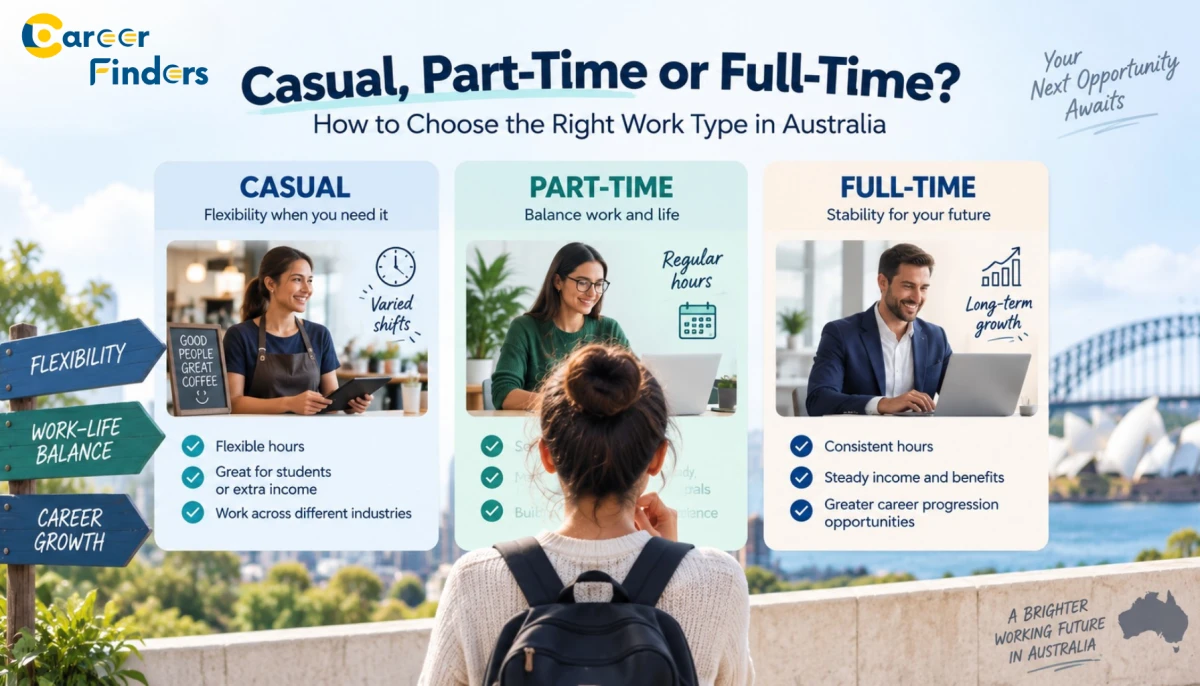
News Insights
Casual, Part-Time or Full-Time? How to Choose the Right Work Type in Australia
Finding the right job is not only about choosing an industry, company or salary. The type of employment you accept can also make a major difference to your working hours, income, flexibility, leave arrangements and long-term career plans.When searching for jobs in Australia, you may regularly see positions advertised as casual, part-time or full-time. For someone entering the workforce for the first time, studying while working, returning after a career break or changing industries, understanding these options can sometimes be confusing.One type of employment is not automatically better than another. The right choice depends on your current situation, financial needs, availability and career goals.Before applying for your next position, it is worth understanding how each employment type generally works and what you should consider before accepting an offer.What Is Full-Time Employment?Full-time employment is often suitable for people who want regular employment, consistent working hours and greater long-term stability.According to the Fair Work Ombudsman, full-time employees generally work an average of 38 ordinary hours per week, although actual hours can vary depending on the occupation, award, enterprise agreement or employment arrangement.Full-time employment may be permanent or offered through a fixed-term arrangement.Full-time employees generally receive minimum employment entitlements under the National Employment Standards, including applicable paid leave.For many job seekers, full-time work can be attractive because it may provide:Regular weekly hoursMore predictable incomePaid annual leavePaid personal or carer’s leaveGreater continuity in the workplaceMore opportunities to take responsibilityStronger long-term career developmentHowever, full-time work also requires a larger weekly time commitment.Before accepting a full-time role, consider whether the expected hours, travel time, roster and responsibilities fit comfortably into your life.What Is Part-Time Employment?Part-time work can provide a useful balance between regular employment and additional flexibility.Fair Work describes part-time employees as generally working fewer than 38 hours per week, with hours that are usually regular. Part-time employees generally receive the same minimum entitlements as full-time workers on a proportional basis, including applicable annual and personal leave.Part-time work can be particularly useful for:StudentsParents and carersPeople completing professional trainingWorkers returning after a career breakPeople managing another job or businessProfessionals who prefer fewer working hoursFor example, a student may work three regular days each week while attending university on the remaining days.This can provide workplace experience and regular income without requiring the same weekly hours as a full-time position.Part-time employment should not automatically be viewed as less valuable for your career. A relevant part-time position can help you build industry knowledge, professional references and practical skills.What Is Casual Employment?Casual employment is common across industries such as hospitality, retail, warehousing, events, administration and customer service.Under current Fair Work rules, casual employment involves specific legal criteria, including whether there is a firm advance commitment to ongoing work and whether the worker is entitled to a casual loading or specific casual rate.Casual work can offer greater flexibility because available shifts may vary.For some job seekers, that can be a major advantage.A university student, for example, may prefer casual work because their availability changes between study periods. Someone returning to the workforce may also use casual employment to rebuild recent experience.Casual employees generally receive a casual loading or specific casual rate, but they do not receive most forms of paid leave available to permanent employees.This is why job seekers should compare more than the hourly rate when evaluating a casual opportunity.Consider the complete employment arrangement.Think About Stability Versus FlexibilityOne of the biggest questions when choosing an employment type is whether you currently value stability or flexibility more.A person with regular financial commitments may prefer predictable hours and income.Another person may need flexibility because they are studying, caring for family members or managing other responsibilities.Ask yourself:Do I need guaranteed or regular working hours?Can I manage if my weekly hours change?Do I need flexibility to manage study or other commitments?Would paid leave be important to me?Am I looking for a temporary opportunity or a longer-term position?There is no single correct answer.The important thing is choosing an employment arrangement that realistically fits your circumstances.Consider Your Career Goals, Not Just Your Current ScheduleYour employment type can also influence your career development.Suppose your long-term goal is to become a restaurant manager.A casual hospitality job may initially help you gain experience, understand restaurant operations and develop customer-service skills.Later, you may decide that a permanent position provides better opportunities to take responsibility, supervise employees or progress towards management.Similarly, a student studying accounting might start with a part-time administration role. Even if the job is not their final career destination, they can develop workplace communication, software, reporting and organisational skills.Think about what the position can help you build.Ask:What will I learn?Will this experience strengthen my resume?Does the position provide skills relevant to my future career?Could there be opportunities to progress?The employment type matters, but the quality and relevance of the experience matter as well.Compare the Complete Job OfferA higher hourly rate does not always mean a job is automatically the better option.When comparing two opportunities, look at the complete employment package.Consider:Expected weekly hoursHourly rate or salaryEmployment typeWork locationTravel expensesRoster arrangementsWeekend or evening requirementsApplicable allowancesLeave arrangementsTraining opportunitiesCareer progressionWorkplace flexibilityFor example, one casual role may offer a higher hourly rate but fewer or less predictable shifts.Another permanent part-time role may provide regular hours and paid leave.Which option is better depends on what matters most to you.Avoid making the decision based on one number alone.Read the Job Advertisement Carefully Before ApplyingJob seekers sometimes apply based only on the title and salary.Before submitting your application, read the full advertisement.Look for information about:Employment status: Casual, part-time, full-time or fixed-term.Working hours: How many hours are expected?Roster: Are weekends, evenings or public holidays required?Location: Is the workplace practical for you?Responsibilities: Can you perform the main duties?Experience: Which requirements are essential and which are preferred?Availability: Does the employer require particular days or shifts?If important information is missing, you can ask about it during the recruitment process.Understanding the position before accepting it can prevent problems later.Can Casual Employment Become Permanent?Casual work does not necessarily mean someone must remain casual permanently.Current Australian workplace rules include an employee choice pathway under which eligible casual employees may be able to notify their employer that they want to change to permanent full-time or part-time employment. Casual employees and employers can also agree to change the employment arrangement at other times.The rules and eligibility requirements can depend on individual circumstances, so employees should check current Fair Work information when considering a change.From a career perspective, this means a casual opportunity can sometimes become the beginning of a longer employment relationship.Your performance matters.Reliability, communication, punctuality, willingness to learn and consistently good work can help you build a positive professional reputation regardless of whether you initially joined casually, part-time or full-time.Which Employment Type Is Best for Students and Graduates?There is no requirement for graduates to immediately find a full-time professional job in order to begin building a career.Casual and part-time positions can provide valuable experience while you search for opportunities related to your qualification.A retail position might strengthen:Customer communicationSales abilityProblem-solvingTeamworkA hospitality role might demonstrate:Time managementWorking under pressureCustomer serviceReliabilityAn administration role might develop:Email communicationData entrySchedulingMicrosoft Office skillsThese abilities can later support applications for graduate and entry-level professional roles.Do not underestimate experience simply because it was casual or part-time.Employers are interested in what you learned and what you were responsible for.Ask the Right Questions Before Accepting a JobReceiving a job offer can be exciting, but you should still understand the employment arrangement before accepting.Useful questions can include:What employment type will I be hired under?How many hours should I normally expect each week?Will my working days be regular or rostered?What are the usual start and finish times?Which award or agreement applies, if relevant?Are weekend or evening shifts expected?What training will be provided?Is there potential for additional responsibilities or career progression?Asking reasonable questions does not make you difficult.It helps both you and the employer understand whether the arrangement is suitable.Final ThoughtsCasual, part-time and full-time employment can all provide valuable opportunities.The best choice depends on where you are in your career and what you need from your next job.If you want regular hours and longer-term stability, full-time employment may suit your goals.If you need regular work with fewer weekly hours, part-time employment may provide a useful balance.If flexibility is particularly important, casual employment may be worth considering.Most importantly, do not judge an opportunity only by its employment label.Look at the hours, pay structure, responsibilities, workplace, learning opportunities and long-term value of the position.A job that suits your current circumstances while helping you develop useful skills can become an important step towards your next career goal.CareerFinders helps job seekers explore employment opportunities and career information across Australia and New Zealand, making it easier to search with greater direction and understand the options available in a changing employment market.1. Fair Work Ombudsman – Full-Time EmployeesFull-time work, average weekly hours and employee entitlements.https://www.fairwork.gov.au/starting-employment/types-of-employees/full-time-employees2. Fair Work Ombudsman – Part-Time EmployeesPart-time hours, regular work patterns and pro-rata leave entitlements.https://www.fairwork.gov.au/starting-employment/types-of-employees/part-time-employees3. Fair Work Ombudsman – Casual Employees / Employment TypesInformation about casual employment, casual loading and employment conditions. https://www.fairwork.gov.au/starting-employment/before-starting-employment4. Fair Work Ombudsman – Becoming a Permanent EmployeeExplains how eligible casual employees can move to permanent full-time or part-time employment through the employee choice pathway. https://www.fairwork.gov.au/starting-employment/types-of-employees/casual-employees/becoming-a-permanent-employee5. Fair Work Ombudsman – National Employment Standards (NES)Official information about minimum workplace entitlements, leave, maximum hours, public holidays and other employment conditions. https://www.fairwork.gov.au/employment-conditions/national-employment-standards6. Fair Work Ombudsman – Minimum WagesUseful reference for minimum pay rates and casual loading. From 1 July 2026, the National Minimum Wage is $26.44 per hour for eligible award/agreement-free adult employees. https://www.fairwork.gov.au/tools-and-resources/fact-sheets/minimum-workplace-entitlements/minimum-wages7. Australian Bureau of Statistics – Understanding Full-Time and Part-Time WorkUseful supporting source explaining how the ABS statistically classifies full-time and part-time employment. https://www.abs.gov.au/articles/understanding-full-time-and-part-time-work8. Fair Work Ombudsman – Casual Employment Information StatementOfficial information employers must provide to casual employees about their employment conditions. https://www.fairwork.gov.au/employment-conditions/information-statements/casual-employment-information-statement#CareerFinders #JobsInAustralia #AustralianJobs #JobSearchAustralia #CareerAdvice #CareerTips #EmploymentAustralia #FullTimeJobs #PartTimeJobs #CasualJobs #JobSeekers #CareerGrowth #WorkInAustralia #EmploymentTips #AustralianWorkplace
05-Sep-2026

News Insights
Top 3 Career Change Mistakes and How to Avoid Them
Changing careers can feel exciting, but it can also bring uncertainty. You may want better pay, more flexibility, stronger career growth, a different work environment, or simply work that feels more suitable for your interests.A career change can open new opportunities, but it works best when it is planned carefully. Many people make the mistake of rushing into a new career without understanding what employers expect or how their existing experience can help them.The good news is that changing careers does not always mean starting again from zero. Your previous experience, skills and knowledge can still be valuable.Here are the top three career change mistakes and practical ways to avoid them.1. Changing Careers Without Proper ResearchOne of the most common mistakes is choosing a new career based only on the job title, salary or what you have seen online.A career may look attractive from the outside, but the actual daily work can be very different.For example, someone may want to move into digital marketing because it sounds creative. However, a digital marketing role can also involve analytics, reporting, campaign planning, deadlines, client communication and performance tracking.Before making a decision, try to understand what the role really involves.Research:Daily responsibilitiesRequired qualificationsEntry-level expectationsCommon tools and softwareAverage salary rangeWorking conditionsCareer progressionSkills employers regularly ask forReading current job advertisements is one of the easiest ways to learn what employers expect.Look at at least 10 to 15 job descriptions for the same type of role. Write down the skills, qualifications and experience that appear repeatedly.This will help you identify what you already have and what you still need to learn.Speak to People Working in the IndustryAnother useful step is talking to someone who already works in your target career.Ask practical questions such as:What does a normal day look like?What skills do you use most?What are the biggest challenges?What qualifications are useful?What would you recommend to someone entering the industry?These conversations can give you a much more realistic understanding of the role.Test the Career Before Making a Big DecisionIf possible, try the new field before leaving your current job.You can explore the industry through:Short coursesVolunteer projectsFreelance workInternshipsPersonal projectsWorkshopsIndustry eventsA small amount of practical experience can help you decide whether the career really suits you.2. Ignoring Your Transferable SkillsAnother major mistake is thinking that your previous experience has no value because you are entering a new industry.This is usually not true.Many skills can be used across different jobs and industries. These are known as transferable skills.Examples include:CommunicationCustomer serviceLeadershipTeamworkProblem-solvingTime managementOrganisationSalesProject coordinationData analysisAdministrationConflict resolutionFor example, someone who has worked in hospitality may want to move into office administration.Hospitality experience may have helped them develop strong communication, organisation, teamwork, customer service and problem-solving skills.These abilities can still be valuable in an office environment.The important part is how you explain them.Update Your Resume for the New CareerDo not use the same resume for every career.Your resume should focus on the skills that are relevant to your target role.Instead of writing:“Worked in a busy restaurant.”You could write:“Managed customer enquiries, coordinated bookings, processed payments and supported daily operations in a fast-paced environment.”This version explains skills that can be useful in many industries.Focus on Achievements, Not Only DutiesEmployers also want to understand the results of your work.Where possible, mention achievements such as:Improving customer satisfactionTraining new staffMeeting sales targetsReducing errorsManaging high workloadsImproving processesHandling difficult situationsThese examples help employers understand the value you could bring to a new role.Update Your LinkedIn ProfileYour LinkedIn profile should also reflect your new career direction.Review your:HeadlineAbout sectionSkillsExperience descriptionsCertificationsProjectsIf your profile only talks about your previous career, recruiters may not understand what type of work you are now looking for.You do not need to remove your previous experience. Instead, connect it to your new career goals.3. Expecting the Career Change to Happen ImmediatelyCareer changes usually take time.Many people become discouraged because they expect to apply for a few jobs and receive an offer quickly.However, you may be competing with candidates who already have direct experience in the industry.This does not mean you cannot succeed. It simply means you may need to build credibility gradually.You might need to:Learn new skillsComplete a short qualificationBuild a portfolioGain practical experienceAttend industry eventsImprove your resumeExpand your networkApply for entry-level positionsBe Realistic About Your First RoleYour first role in a new industry may not be your ideal job.You may need to start with:A junior roleA temporary positionA contract rolePart-time workAn internshipA slightly lower salaryThis can sometimes be a smart career move.Your first position can give you the experience, contacts and industry knowledge needed to move into stronger opportunities later.For example, someone moving into human resources might start as an HR assistant or recruitment coordinator before progressing into an HR advisor position.The first role acts as a bridge between your previous career and your new one.Build a Simple Career Change PlanInstead of making a sudden move, create a simple plan.Start by asking yourself:Why do I want to change careers?Your answer should be clear.Maybe you want:Better work-life balanceHigher earning potentialMore career growthMore flexible working optionsBetter job stabilityA more interesting work environmentOnce you understand your reason, research careers that match your goals.Next, divide your skills into three groups.Skills you already haveThese can be highlighted immediately.Skills you need to improveThese may require training or practice.Experience you still needThis can be gained through projects, volunteering, internships or entry-level work.This simple process can make your transition much easier to manage.Final ThoughtsChanging careers can be challenging, but it can also lead to better opportunities and greater job satisfaction.The three biggest mistakes are changing careers without research, ignoring transferable skills and expecting immediate results.Take time to understand the industry before making the move. Identify the skills you already have and learn how to present them clearly. Be realistic about how long the transition may take and remain open to junior or temporary opportunities that can help you gain experience.A successful career change does not usually happen overnight.With research, patience and a clear plan, you can make the transition with more confidence and create a stronger path toward your next career.Sources and References1. myGov – Changing Your Careerhttps://my.gov.au/en/services/education/upgrading-professional-skills-or-qualifications/changing-your-careerAustralian Government guidance on assessing existing skills, identifying skill gaps and preparing for a new career.2. Your Career – Considering a Career Changehttps://www.yourcareer.gov.au/support/career-changePractical guidance on researching career options, reskilling, networking and preparing for a career transition.3. Your Career – Skills for the Futurehttps://www.yourcareer.gov.au/resources/australian-jobs-report/skills-for-the-futureExplains how transferable skills can help people move between occupations and identify new career opportunities.4. NSW Government – Enhancing Your Soft Skills When Changing Careershttps://www.nsw.gov.au/employment/my-career-planner/getting-a-job/changing-careers/upskilling-and-retraining/enhancing-your-soft-skillsCovers transferable skills such as communication, teamwork, adaptability, problem-solving and critical thinking.5. NSW Government – Career Changer Resumes and Cover Lettershttps://www.nsw.gov.au/employment/my-career-planner/getting-a-job/resumes-cvs-cover-letters/profiles-by-career-stage/career-changerUseful advice on highlighting transferable skills and tailoring a resume when moving into a different industry.6. Workforce Australia – Explore Career Optionshttps://www.workforceaustralia.gov.au/individuals/coaching/careersProvides tools for exploring new careers, training options and jobs that match existing skills.#CareerChange #CareerAdvice #CareerGrowth #JobSearchTips #ProfessionalDevelopment #TransferableSkills #CareerPlanning
04-Sep-2026