

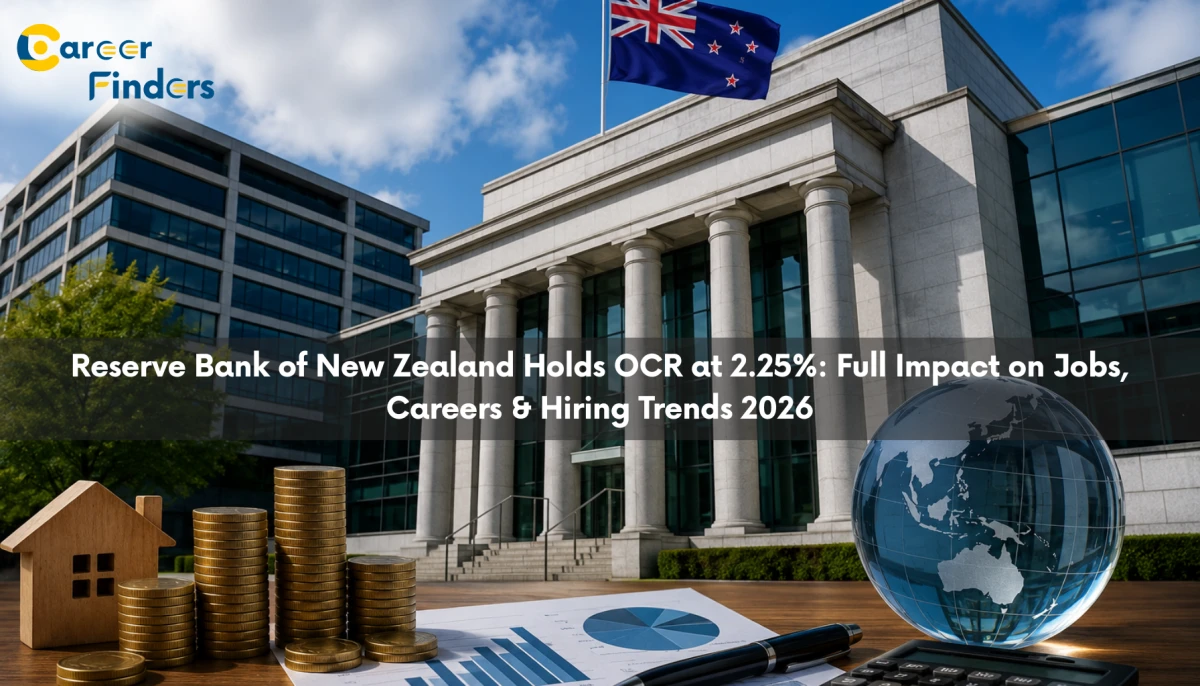
The Reserve Bank of New Zealand (RBNZ) has announced its latest monetary policy update, confirming that the Official Cash Rate (OCR) will remain unchanged at 2.25%.
This decision comes at a time when New Zealand’s economy is balancing inflation control, cost-of-living pressures, global uncertainty, and a gradually stabilising labour market.
Original source:
https://www.stuff.co.nz/nz-news/360984555/reserve-bank-set-reveal-latest-official-cash-rate-decision
While the announcement may appear technical or financial on the surface, its impact is far-reaching. The OCR influences everything from mortgage rates and business loans to hiring trends, wage growth, student opportunities, and long-term career planning.
The Official Cash Rate (OCR) is the interest rate set by the Reserve Bank of New Zealand to control inflation and manage economic stability.
It affects:
When the OCR is held steady at 2.25%, it signals that the Reserve Bank is attempting to maintain economic balance without triggering either overheating or recessionary pressure.
The decision to maintain the OCR reflects several underlying economic conditions:
Inflation has eased compared to previous peaks, but it has not fully stabilised within the target band. This requires continued caution from policymakers.
International factors such as:
continue to influence New Zealand’s economic outlook.
Consumer spending is not consistent across sectors. Essential goods remain stable, but discretionary spending is still cautious.
Employment levels remain relatively stable, but wage pressure and skill shortages continue in specific industries.
Holding the OCR at 2.25% creates a “controlled stability environment” in the economy.
This means:
However, this stability is not equal across all sectors.
Some industries benefit, while others remain under pressure.
The OCR decision has a direct and indirect effect on employment trends across the country.
Employers are not expected to expand aggressively. Instead, hiring will focus on:
This results in a “selective hiring market” where quality matters more than quantity.
Job seekers will face:
Entry-level roles will remain competitive due to limited expansion hiring.
Employers are increasingly prioritising:
This shift is especially strong in sectors affected by economic slowdown.
Employment trends may vary depending on region:
Students entering the job market in 2026 face a more structured and competitive environment.
Internships are becoming essential because employers prefer candidates with:
Companies are becoming more selective with structured graduate hiring programmes due to cost constraints.
Students should focus on:
Career decisions are increasingly influenced by economic conditions, not just academic pathways.
For employers, the OCR stability brings predictability—but not necessarily expansion confidence.
Businesses are prioritising:
Employers are balancing:
This results in moderate salary increases rather than aggressive wage growth.
There is growing use of:
Highly sensitive to interest rates. Activity remains cautious due to borrowing costs and housing demand fluctuations.
Stable but under pressure from reduced discretionary spending.
Strong demand continues due to structural workforce shortages.
One of the strongest sectors with continued hiring demand despite economic uncertainty.
Steady demand, with growing emphasis on upskilling and vocational training.
Moderate growth supported by supply chain stabilisation.
Wage growth is influenced by both inflation and labour demand.
Current trends indicate:
Employees seeking higher income growth may need to:
The New Zealand economy is expected to remain in a transition phase throughout 2026.
Key expectations:
Future OCR changes will depend on:
For individuals, the current environment requires a more strategic approach to careers.
At Careerfinders.co.nz, we track economic indicators like the OCR because they provide early signals about:
Understanding these signals helps:
The Reserve Bank of New Zealand’s decision to maintain the OCR at 2.25% reflects a carefully balanced approach to economic stability. While it reduces financial volatility, it also signals a period of controlled and cautious growth.
For the labour market, this means:
In 2026, success in the job market will depend less on timing and more on skills, preparation, and adaptability to economic change.
sources Links
(1) AI and automation are making the job market more competitive in 2026
The rise of AI-driven hiring systems and automation is reshaping recruitment, making it harder for candidates without digital and AI-adapted skills.
https://www.theguardian.com/technology/ng-interactive/2026/apr/25/gen-z-entrepreneurs-business-ai
(2) Targeted job search strategies outperform mass applications
Candidates who use focused job applications, recruiter outreach, and networking strategies are achieving higher success rates than those applying in bulk.
https://www.businessinsider.com/job-seeker-landed-role-from-reddit-hack-find-recruiter-email-2026-4
(3) Most resumes are filtered by AI before human review
Studies suggest around 75% of resumes never reach human recruiters due to Applicant Tracking Systems (ATS) and AI screening tools.
https://www.techradar.com/pro/75-of-resumes-never-reach-a-human-heres-the-hidden-reason-your-application-is-getting-rejected-by-ai
(4) Recruiters are still essential—but verification is important
Recruiters play a key role in hiring, but candidates must verify legitimacy to avoid scams and fake job offers.
https://www.wsj.com/lifestyle/careers/a-recruiter-found-you-or-is-it-a-scam-d912159a
(5) Hiring is shifting away from traditional resume-based systems
Some companies are experimenting with skill-based hiring models instead of relying only on resumes and CVs.
https://timesofindia.indiatimes.com/life-style/spotlight/no-resume-hiring-founders-bold-recruitment-strategy-goes-viral/articleshow/130531694.cms
#ReserveBankNZ #OCRDecision2026 #NZEconomy #NewZealandJobs #JobMarketNZ #HiringTrendsNZ #CareerAdviceNZ #StudentJobsNZ #GraduateCareers #EmploymentNZ #WageGrowthNZ #InterestRatesNZ #RBNZOCR #NZBusinessNews #EconomicUpdateNZ #CareerPlanning #JobSearchNZ #WorkNZ #FutureOfWorkNZ #SkillsBasedHiring #NZCareers