

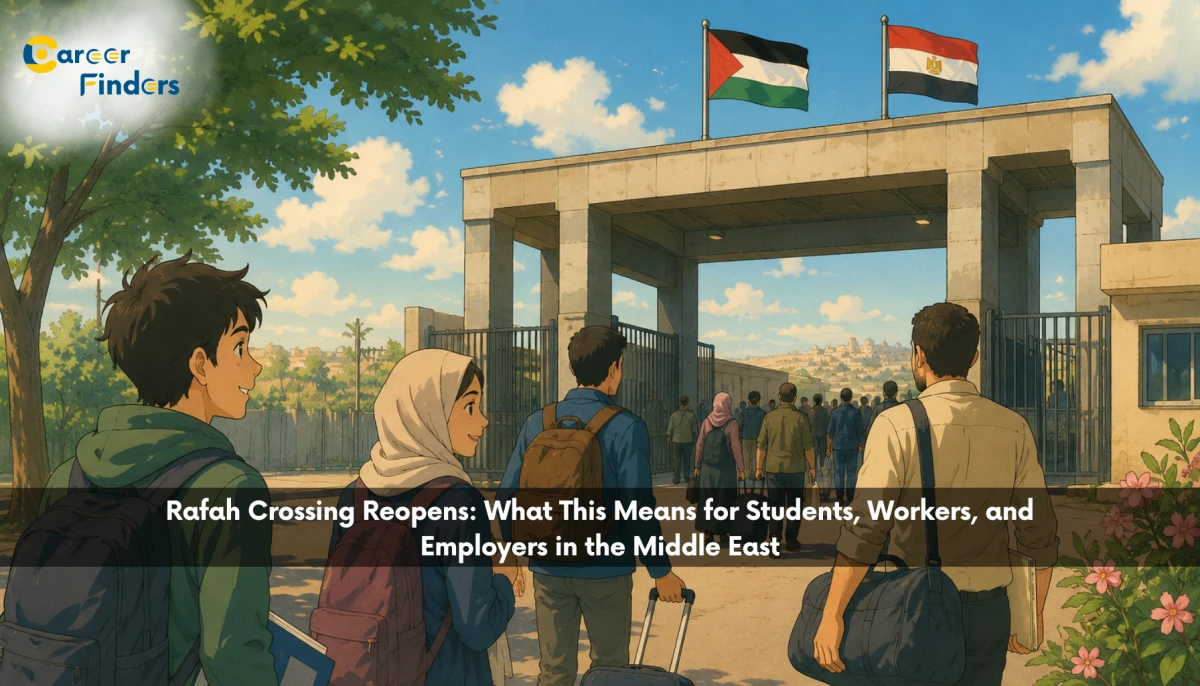
After months of complete shutdown, the Rafah border crossing between Gaza and Egypt is set to reopen in both directions, allowing limited civilian movement for the first time since mid-2024.
While this development is being covered largely as a geopolitical update, its career, education, and workforce implications are being overlooked. That is a mistake.
For students, migrant workers, employers, and international institutions, this reopening creates practical consequences that directly affect mobility, hiring pipelines, and workforce continuity.
The Rafah crossing is not just a border. It is the only non-Israeli controlled exit point from Gaza. When it closed, thousands of people were trapped with no access to:
• Overseas education
• International employment
• Family sponsored work routes
• Academic admissions already approved
Its partial reopening reactivates stalled human capital movement.
That matters to employers and institutions.
Many students from Gaza have had confirmed university admissions abroad that were frozen due to border restrictions.
With controlled reopening:
• Students can resume international study plans
• Universities may see deferred intakes reactivated
• Scholarship holders regain mobility
• Academic continuity becomes possible again
For education providers, this is a signal to reassess deferred offers and enrollment pipelines.
For skilled and semi-skilled workers:
• Existing overseas job offers can resume
• Employment visas that were at risk can be salvaged
• Cross-border family sponsorship cases may restart
• Remote and contract roles become feasible again
This directly affects sectors dependent on international labour mobility, including healthcare, construction, education, logistics, and NGOs.
Employers recruiting from or operating near conflict-affected regions must understand this clearly:
This reopening is people-only, not goods.
Movement is limited and security-cleared.
Numbers will be controlled.
That means:
• Candidate availability improves gradually, not instantly
• Workforce planning must remain conservative
• Documentation and compliance checks are critical
• Hiring timelines should include border-clearance buffers
Employers who ignore these realities will miscalculate hiring capacity.
Source:Times of Israel
https://www.timesofisrael.com/israel-confirms-gazas-rafah-crossing-will-reopen-sunday-in-both-directions/
This is not a local issue.
Border access directly affects:
• International graduate hiring
• Humanitarian staffing
• NGO workforce rotation
• Education sector staffing
• Cross-border remote employment models
Global employers and institutions that track mobility signals early gain talent access advantages later.
Source:Reuters
https://www.reuters.com/world/middle-east/gazas-rafah-crossing-with-egypt-reopen-sunday-israels-cogat-says-2026-01-30/
Labour mobility disruptions do not end careers.
They delay them.
The reopening of Rafah is an early signal of gradual workforce re-entry, not full normalization.
Students should prepare documents now.
Workers should reactivate applications.
Employers should reassess candidate pipelines, not rush them.
Ignoring this development means losing timing advantage.
If your hiring, education, or workforce strategy touches the Middle East, this reopening is not optional information.
It is operational intelligence.
CareerFinders will continue tracking how geopolitical shifts translate into real hiring and education outcomes, not headlines.
• Times of Israel
https://www.timesofisrael.com/israel-confirms-gazas-rafah-crossing-will-reopen-sunday-in-both-directions/
• Associated Press
https://apnews.com/article/823d4b0aef641c3f19d4cc7b527325b1