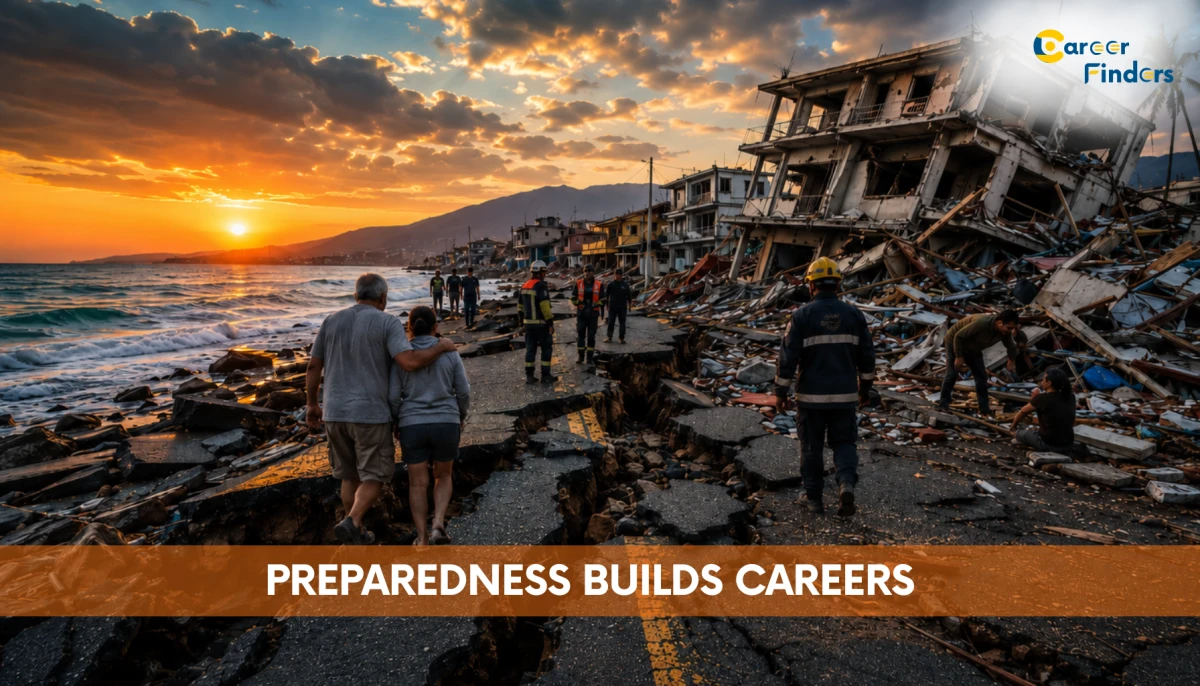
A powerful earthquake near the southern Philippines has again reminded the world how quickly natural disasters can affect people, workplaces, transport systems, schools, hospitals, coastal communities and businesses.
The earthquake struck near Mindanao in the southern Philippines and was widely reported as a major seismic event. The USGS listed it as magnitude 7.8, while some early reports and alerts referred to magnitude 8.2. The quake triggered tsunami warnings and regional monitoring across parts of the Pacific. New Zealand’s National Emergency Management Agency later said there was no tsunami threat to New Zealand, based on its assessment of available information.
For many people, this may look like only a breaking news story. But for students, job seekers, employers and training providers, it also shows something bigger: the growing importance of disaster-ready skills, emergency planning, infrastructure safety, workplace preparedness and risk management careers.
Natural disasters do not only affect homes. They can also affect airports, ports, schools, hospitals, construction sites, supply chains, power systems, internet networks, offices and local businesses. When an earthquake or tsunami warning happens, many different professionals are needed to protect people, manage risk and support recovery.
The Philippines is located in a highly active earthquake zone, often affected by seismic activity because of its position along the Pacific Ring of Fire. This makes earthquakes, aftershocks and tsunami alerts an important part of disaster preparedness in the region. Reports said tsunami waves were recorded in nearby coastal provinces, and the Pacific Tsunami Warning Center warned of possible waves affecting parts of the Philippines, Indonesia and Malaysia.
The earthquake also created wider regional concern. The Guardian reported tsunami warnings across several Pacific areas, while authorities urged people in coastal zones to move to higher ground.
For countries such as New Zealand, Australia and other Pacific-facing nations, these events are a reminder that emergency monitoring systems must stay active. New Zealand’s NEMA said the country’s coastline and some larger lakes are at risk of tsunami because of its Pacific location and geography. NEMA also explains that its DART buoy network helps detect tsunami activity and supports faster, more accurate warnings.
This is why natural disaster news is also career news. Every major emergency needs trained people, reliable systems and strong coordination.
Earthquakes and tsunami warnings can disrupt workplaces in many ways. Even if a company is not directly damaged, its staff, customers, suppliers or transport routes may be affected.
Businesses may face:
This is why employers need more than a basic safety notice on the wall. They need practical emergency plans, trained staff and clear communication systems.
A business that prepares early can respond faster during a crisis. A business that does not prepare may face confusion, downtime, safety risks and financial losses.
This type of event shows the growing value of practical, safety-focused and problem-solving skills. Students and job seekers can use this news to understand which career areas may become more important in the future.
Important skills include:
These skills are useful across many industries, including healthcare, construction, government, education, transport, logistics, engineering, security and technology.
For students, disaster-related news can help connect classroom learning with real-world career opportunities. Natural disasters require people from many professional backgrounds, not only emergency workers.
Students can explore careers such as:
A student studying engineering may later work on safer buildings and bridges. A student studying IT may help build alert systems or protect emergency communication networks. A healthcare student may support hospitals during emergency situations. A logistics student may help move food, medicine and emergency supplies when roads and transport systems are disrupted.
This shows that career planning should not only focus on popular job titles. Students should also think about industries that protect people, support infrastructure and help communities recover.
Employers should treat this news as a reminder to review their own workplace preparedness. Natural disasters can happen suddenly, and businesses need to know how they will protect staff and continue operations.
Employers should ask:
Workplace safety is not only a compliance issue. It is also a leadership issue. Employees need to feel that their employer is prepared, organised and serious about safety.
The modern job market is changing. Employers are not only looking for people with technical skills. They also need people who can stay calm, solve problems and respond responsibly during difficult situations.
Natural disasters, severe weather events, floods, fires and earthquakes can affect business operations at any time. Even companies that are far away from the disaster area can still be affected through supply chains, travel disruptions or customer delays.
This is why disaster-ready skills are becoming more valuable. People who understand safety planning, emergency response, logistics, communication and risk management can bring real value to employers.
For job seekers, adding these skills to a resume can be useful. Even basic training in first aid, workplace safety, risk assessment or crisis communication can show that a candidate is responsible and practical.
Job seekers do not always need a university degree to start building disaster-ready skills. Some skills can be developed through short courses, workplace training, volunteer experience and practical learning.
Useful steps include:
These steps can help candidates become stronger applicants for roles in operations, safety, administration, healthcare, logistics, construction and public services.
Training providers can also learn from this type of news. Students need courses that connect theory with real-world situations.
Courses in construction, engineering, healthcare, IT, logistics and business should include practical examples of emergency planning, safety compliance and crisis response. This makes learning more useful and helps students understand how their future work may affect real people.
For example, a construction course can include earthquake-resistant building awareness. A business course can include continuity planning. An IT course can include emergency system backup and cybersecurity. A healthcare course can include emergency patient response.
The more practical the training, the more job-ready the students become.
Technology plays a major role in modern emergency response. Warning systems, mobile alerts, satellite data, sensors, mapping tools and communication platforms help authorities assess risk and warn people faster.
New Zealand’s DART network, for example, uses deep-ocean instruments to detect changes in sea level and support tsunami warnings. NEMA says DART stations send data through satellite and monitoring systems so experts can assess the threat and issue public warnings if needed.
This creates career opportunities in technology as well. IT professionals, software developers, data analysts, cybersecurity specialists and communication system experts all play a part in emergency preparedness.
In the future, artificial intelligence, real-time data systems and automated alerts may become even more important in disaster monitoring and response.
The Philippines earthquake and tsunami alert is a serious news event, but it also gives a clear career lesson. The world needs skilled people who can build safer systems, support emergency response and help organisations stay prepared.
For students, this is a chance to explore meaningful careers that support communities. For job seekers, it is a reminder to build practical skills that employers value. For employers, it is a warning to review safety planning and hire people who can manage risk.
Disaster preparedness is not only about reacting after something happens. It is about planning before the crisis, training people properly and building systems that protect lives.
The earthquake near the southern Philippines shows how quickly a natural disaster can create regional concern. Tsunami warnings, emergency assessments and public safety updates are not just government responsibilities. They involve many workers, industries and systems.
For CareerFinders.co readers, the message is clear: safety, resilience and emergency preparedness are becoming important parts of the modern career landscape.
Students should consider careers that support infrastructure, health, technology and public safety. Job seekers should build practical skills that show responsibility and readiness. Employers should review their emergency plans and invest in people who can help protect both workers and business operations.
Natural disasters cannot always be prevented. But with the right skills, planning and workforce preparation, communities and businesses can respond better and recover faster.