

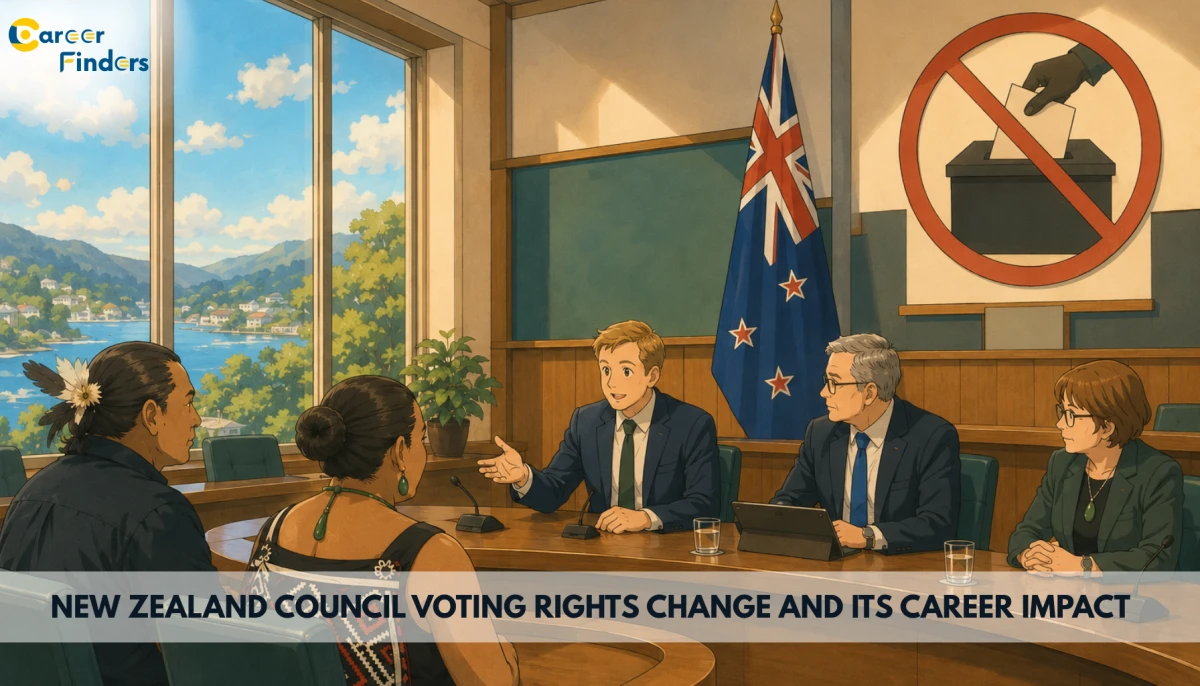
New Zealand’s Government has announced a major local government change that would restrict voting rights on council committees to elected councillors only. This means non-elected representatives, including iwi representatives, youth representatives and other appointed community members, may still be invited to give advice, share community views and support discussion, but they would not be able to vote in council committee decisions or count toward quorum.
At first, this may sound like a political or council-only issue. But for students, job seekers, employers and recruiters, this news connects directly with the future of work in public administration, governance, policy, law, community development, compliance and leadership.
The change highlights a clear message: modern careers are not only about technical skills. They also require an understanding of accountability, decision-making, community representation, stakeholder communication and public trust.
Local Government Minister Simon Watts said the Government is amending the Local Government Act 2002 so that only elected members will hold voting rights at council committee meetings. The Government’s position is that councillors are directly accountable to voters, and therefore voting power should sit with people elected by the public.
However, the Government has also said councils will still be able to appoint non-elected members to provide advice, represent community voices and contribute specialist knowledge. The main difference is that those appointed members would not hold voting rights. Statutory committees and appointments connected to Treaty settlement arrangements are expected to be excluded from the change.
The proposed change is being included in the Local Government System Improvements Bill. According to the official announcement, once the law is passed, councils will have six months to review their committee structures, delegations and appointments.
This news is important because councils are major employers and decision-makers. Local governments deal with infrastructure, roads, housing planning, water services, environmental management, community facilities, public events, regulatory approvals, local economic development and social services.
That means decisions made by councils affect many industries, including:
For students and job seekers, this creates a strong career lesson: public sector jobs require people who understand how decisions are made, who has authority, how consultation works and why accountability matters.
Councils often use committees to examine issues in detail before decisions are made. Local Government New Zealand explains that standing committees allow councils to delegate decision-making or detailed investigation to smaller groups of elected members, and some committees have decision-making authority while others are advisory.
This is why voting rights on committees matter. A committee may influence decisions about budgets, infrastructure, planning, community services, grants, environmental policy or council operations. When voting power changes, the decision-making structure also changes.
For career-focused readers, this is a useful example of how governance works in real life. It shows the difference between advice, representation, consultation and formal decision-making authority.
Students studying law, political science, public policy, social work, business, urban planning, community services, Māori studies, communications or public administration can learn a lot from this development.
This issue shows that public sector careers involve more than classroom theory. Students need to understand real policy changes, government structures and how laws affect communities.
Students can use this news to build knowledge in areas such as:
A student who understands these areas can be better prepared for internships, graduate roles and entry-level jobs in councils, government agencies, NGOs, policy teams and community organisations.
Local government creates career opportunities across many departments. Students and job seekers who follow these policy changes can better understand where future jobs may come from.
Possible career paths include:
Policy Assistant
Helps research issues, prepare reports and support policy development.
Governance Officer
Supports council meetings, agendas, minutes, compliance and decision-making processes.
Community Engagement Officer
Works with residents, iwi, businesses and community groups to collect feedback and support public consultation.
Public Administration Officer
Manages council services, documentation, internal coordination and public requests.
Compliance Officer
Ensures organisations and public projects follow relevant laws, regulations and council rules.
Urban Planning Assistant
Supports planning applications, land-use decisions and development projects.
Communications Officer
Explains council decisions, public consultations and policy updates to the community.
Legal Support Officer
Assists with local government legal documents, legislation, governance rules and regulatory matters.
Stakeholder Relations Coordinator
Builds communication between councils, community groups, government bodies and businesses.
Employers should not ignore this news, especially if their business works with councils or government-related projects.
Businesses in construction, training, infrastructure, housing, transport, environmental services, aged care, disability support, community programs and public consulting often need council approvals or council partnerships.
When governance rules change, employers need staff who can understand:
Who has decision-making authority
How council committees work
How public consultation affects projects
How to prepare professional submissions
How to communicate with government stakeholders
How to manage compliance documentation
How to reduce project approval risks
This is why governance knowledge is becoming a valuable workplace skill.
Recruiters hiring for public sector, compliance, policy, legal, planning, education or community roles should look beyond basic qualifications. Candidates who understand governance and public accountability may be more valuable for roles involving government interaction.
Recruiters can assess candidates for skills such as:
Report writing
Policy research
Stakeholder engagement
Public speaking
Meeting coordination
Legislation awareness
Cultural awareness
Risk management
Professional communication
Decision-making support
This is especially important for roles where employees need to work with councils, elected members, community representatives or regulatory bodies.
The Government says this change is about democratic accountability. Whether readers support or oppose the decision, the career lesson is clear: accountability is central to public sector work.
In any public-facing role, decisions must be documented, justified and communicated clearly. Employees working in government, councils, education, community services or compliance-heavy industries must understand that their work affects real people.
This is why employers increasingly value candidates who can show:
Responsible judgement
Clear communication
Ethical behaviour
Understanding of rules and processes
Respect for community voices
Ability to work with diverse stakeholders
Professional documentation skills
Although the Government’s proposed change would remove voting rights from non-elected committee members, councils may still appoint people to provide advice and represent community perspectives.
This distinction is important. Representation and advice may continue, but formal voting power would sit with elected councillors. For students and professionals, this creates a valuable discussion point: how can institutions balance democratic accountability with inclusive community participation?
This question is highly relevant for careers in social policy, Māori relations, public consultation, law, government communication and community development.
This news also sits within a wider national conversation about Māori representation in local government. Recent changes around Māori wards and local democracy have already created strong public debate in New Zealand. The Guardian reported that referendums led to several councils removing guaranteed Māori seats, while supporters framed the changes as restoring local democracy and critics argued they weakened Indigenous representation.
For CareerFinders readers, the important point is not only political. The important point is that future professionals must be able to understand complex public debates, work respectfully with diverse communities and communicate within legal and cultural frameworks.
Students who want careers in public sector or governance-related roles should start developing practical skills now.
Important skills include:
Research Skills
Learn how to read government announcements, policy papers and council reports.
Writing Skills
Practice writing summaries, briefing notes, reports and professional emails.
Communication Skills
Learn how to explain complex issues in simple language.
Legal Awareness
Understand how laws, regulations and public procedures affect decision-making.
Meeting Skills
Learn how agendas, minutes, motions, voting and quorum work.
Cultural Awareness
Understand the role of iwi, Māori representation and community participation in New Zealand governance.
Stakeholder Management
Learn how to communicate with different groups, including residents, businesses, councils and community organisations.
Job seekers applying for government, council or community roles can include relevant keywords in their resume, where accurate:
These keywords can help align a resume with public sector and governance-related job descriptions.
Employers can use this news as a reminder to strengthen internal governance skills.
They can:
This is especially useful for employers working in regulated industries or public-facing projects.
The New Zealand council voting rights change is more than a political update. It is a strong example of how governance, accountability and representation affect careers, workplaces and public decision-making.
For students, this is a learning opportunity. For job seekers, it is a chance to build skills that match public sector and governance jobs. For employers, it is a reminder that staff need more than technical knowledge; they need communication, compliance, cultural awareness and decision-making skills.
As local government systems continue to evolve, career success will depend on the ability to understand rules, respect communities, communicate clearly and work responsibly within public institutions.