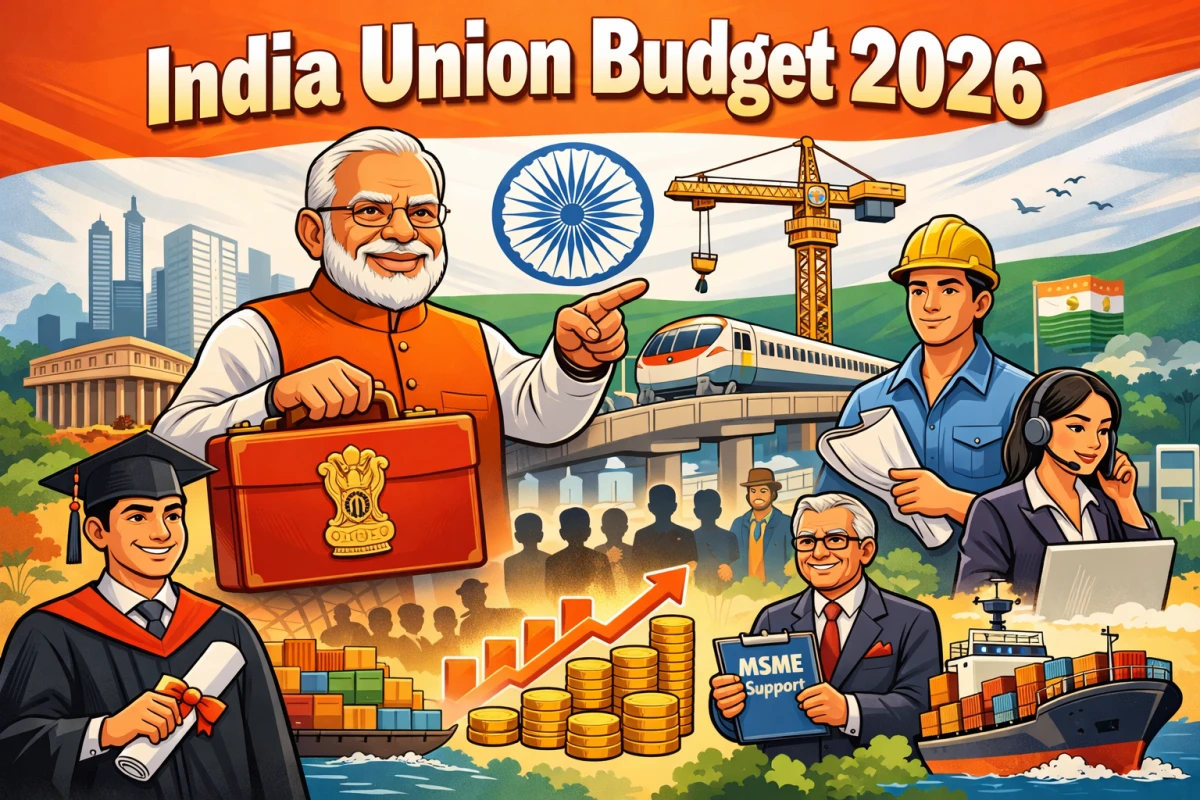
India’s Union Budget 2026–27 is more than a yearly financial statement. It is a major policy signal for job seekers, employers, students, exporters, small businesses, and industries that depend on stable economic growth.
At a time when global trade pressure, tariff uncertainty, and shifting international markets are affecting business decisions, the budget presents a clear direction: protect Indian businesses, strengthen employment-generating sectors, support exporters, and create stronger pathways for future hiring.
According to a detailed report by NDTV, the government has positioned the Union Budget 2026 as a strategic response to external tariff threats while supporting domestic industries, MSMEs, infrastructure, and export-driven growth.
The impact of the Union Budget on jobs in India can be seen most clearly in three major areas: MSMEs, infrastructure, and exports.
These sectors are directly connected to employment. When small businesses receive support, factories keep running, service providers continue operations, and companies remain confident about hiring.
MSMEs are one of the strongest employment engines in India. They support millions of workers across manufacturing, retail, logistics, services, textiles, construction, and trade. A dedicated growth push for small and medium enterprises can help these businesses manage cash flow, handle market pressure, and avoid sudden workforce cuts.
For job seekers, this means more stability in the employment market. For employers, it means better confidence to retain staff, expand teams, and invest in future hiring.
Support for MSMEs and Small Businesses
Small and medium enterprises often face the biggest pressure during global uncertainty. Rising costs, tariff changes, reduced export demand, and payment delays can directly affect their ability to hire and retain workers.
The budget’s focus on MSME support is important because these businesses are closely linked with local employment.
When MSMEs grow, they create demand for:
Administrative staff Sales and marketing professionals Machine operators Warehouse workers Accountants Delivery and logistics teams Skilled trade workers Customer support staff Technical and digital roles
This makes MSME support not just a business policy, but an employment policy.
For CareerFinders readers, this is an important signal. Job seekers should monitor small and medium enterprises in manufacturing, logistics, services, construction, and export-linked industries because these areas may see gradual hiring improvement.
Infrastructure Spending and Long-Term Hiring
Another major employment area connected to the budget is infrastructure.
Infrastructure projects create direct and indirect jobs. Direct jobs include engineers, project managers, construction workers, machine operators, surveyors, safety officers, and site supervisors. Indirect jobs come from transport, materials, equipment supply, administration, maintenance, and local services around project locations.
When the government increases or maintains strong infrastructure spending, businesses connected to roads, ports, rail, housing, energy, and industrial development also gain confidence.
This can create opportunities for:
Civil engineers Construction managers Electricians Plumbers Heavy vehicle operators Logistics coordinators Procurement officers Safety supervisors Skilled labourers Project administrators
For students and early-career professionals, infrastructure-linked sectors can become strong career pathways, especially for those with technical, vocational, engineering, and project management skills.
Exporters Get a Strong Policy Signal
One of the most important themes of this budget is support for Indian exporters.
Export-oriented industries such as textiles, furniture, engineering goods, manufacturing, food processing, and industrial products are deeply connected to employment. These businesses depend on international demand, trade stability, and government support when global tariffs create pressure.
Budget support for exporters can help companies continue production, protect jobs, and remain competitive in international markets.
This matters because export industries do not only employ factory workers. They also support jobs in:
Quality control Packaging Shipping Documentation International sales Customs and compliance Digital marketing Warehouse management Supply chain operations
For workers, this means export-focused industries may remain important employment zones. For employers, the budget provides a reason to reassess hiring plans instead of delaying recruitment due to uncertainty.
For employers and recruiters, the Union Budget reduces uncertainty.
Businesses are more likely to hire when they feel confident about policy support, market stability, and future demand. The budget’s focus on MSMEs, infrastructure, exports, and skill development gives employers a clearer view of where economic activity may increase.
Employers should pay attention to:
Greater infrastructure spending that may support project-based hiring MSME funding that can improve business stability Export safeguards that may protect international revenue pipelines Skill development initiatives that can improve candidate readiness Industry support that can reduce sudden workforce disruption
However, employers should also avoid overestimating immediate results. Budget announcements do not create jobs overnight. The effect usually appears gradually as policies are implemented, funds are released, projects begin, and businesses respond.
Recruiters should use this period to identify growth sectors, prepare hiring pipelines, and build talent pools in industries likely to benefit from the budget.
What Students and Job Seekers Should Watch
For students, fresh graduates, and job seekers, the Union Budget gives a clear message: skills matter more than ever.
The strongest opportunities are likely to appear in sectors where government policy, business investment, and workforce demand are moving in the same direction.
Job seekers should pay attention to career opportunities in:
Manufacturing Infrastructure Construction Logistics Exports Industrial operations Digital business support Skilled trades Vocational roles Technical services
Students should also focus on practical skills that match employer demand. A degree alone may not be enough in a competitive job market. Employers increasingly want candidates who understand tools, processes, communication, compliance, and workplace expectations.
Government-backed skill initiatives aligned with employment can be explored via Skill India: https://www.skillindia.gov.in
Why Skill Development Is Now Linked to Hiring
One of the biggest lessons from the Union Budget is that employment and skill development are no longer separate discussions.
When the government supports sectors like manufacturing, infrastructure, exports, and MSMEs, employers need workers who can actually perform in those industries. This creates a strong need for job-ready skills.
Job seekers should focus on:
Industry-specific knowledge Communication skills Digital literacy Resume and interview preparation Technical certifications Workplace safety understanding Problem-solving skills Practical training Internship experience
This is especially important for early-career candidates. The candidates who connect their skills with growing sectors will be better positioned than those applying randomly across unrelated roles.
CareerFinders.co Perspective
The Union Budget 2026 reinforces a major trend: policy decisions directly shape job markets.
When the government supports businesses, protects exporters, strengthens infrastructure, and promotes skill development, the employment market receives a confidence boost. This does not mean every sector will grow equally, but it does show where job seekers and employers should focus their attention.
For employers, this is the time to plan hiring carefully and watch sector-specific opportunities.
For students, this is the time to build practical, job-ready skills.
For job seekers, this is the time to align applications with industries that are receiving policy support.
For exporters and small businesses, this budget may provide stability during a period of global trade uncertainty.
Final Word
India’s Union Budget 2026 is not only about numbers. It is about direction.
It shows where the government expects growth, where businesses may receive support, and where job opportunities may develop.
For CareerFinders readers, the message is simple: follow the sectors that policy is supporting. MSMEs, infrastructure, exports, manufacturing, skill development, and industrial growth are areas to watch closely.
Job seekers should prepare early. Students should upgrade skills. Employers should review hiring plans. Businesses should track implementation updates.
CareerFinders.co will continue monitoring how government policy, business growth, and labour market trends affect real career opportunities.