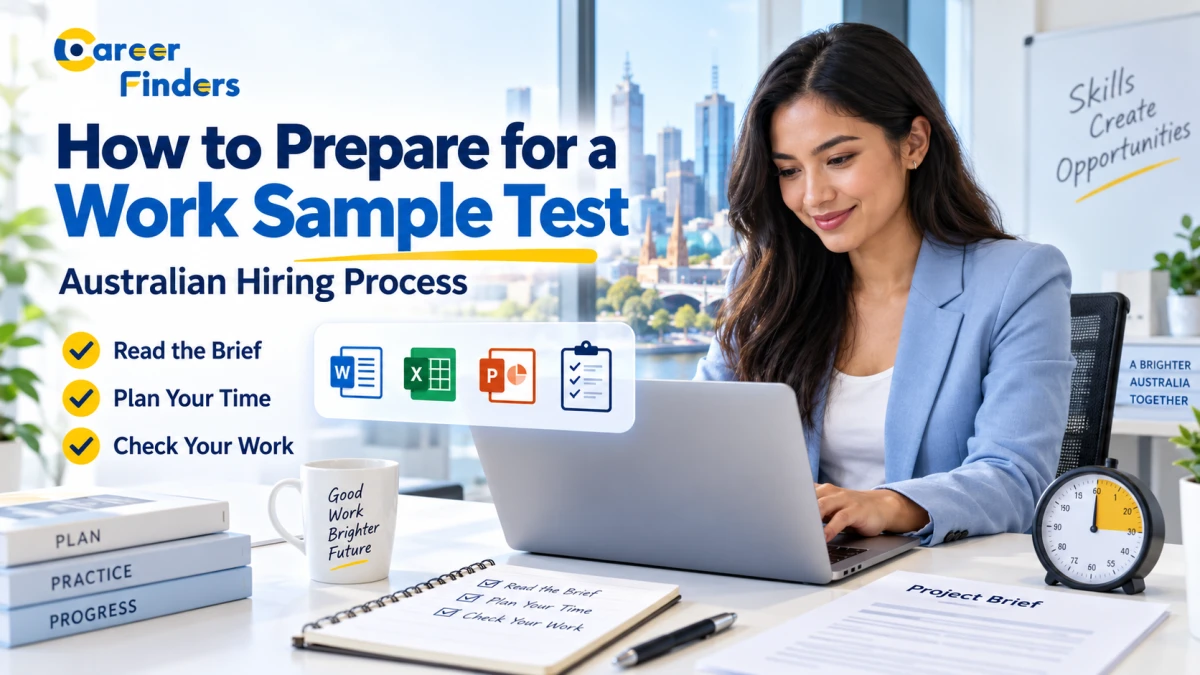
Australian employers are increasingly using work sample tests to understand what candidates can actually do. A strong resume may help you reach the next stage, but a practical task gives the employer direct evidence of your skills, judgement and working style.
A work sample test can feel stressful, especially when you do not know what to expect. However, it is also an opportunity. Instead of relying only on interview answers, you can demonstrate how you approach a realistic workplace problem.
This guide explains what work sample tests are, why employers use them and how you can prepare confidently during the Australian hiring process.
1. Understand What a Work Sample Test Is
A work sample test is a practical activity designed to reflect tasks from the advertised position. It may be completed online, at the employer’s workplace or during an assessment centre.
The format depends on the role. For example:
A writer may prepare a short article.
A designer may create a simple visual concept.
An administrator may organise information in a spreadsheet.
A customer service candidate may respond to a difficult enquiry.
A developer may complete a coding task.
A manager may analyse a business problem and present recommendations.
The employer is usually checking more than the final answer. They may also consider how you organise information, follow instructions, manage time and explain your decisions.
2. Read Every Instruction Carefully
Many candidates begin too quickly because they want to finish before the deadline. This can lead to avoidable mistakes. Read the complete brief before starting and highlight the important requirements.
Check the required format, word limit, deadline, audience and submission method. Identify whether you need to use particular software, provide sources or explain your process.
Create a simple checklist and review it before submitting. A strong answer that ignores one important requirement may still receive a low assessment.
3. Research the Role and Employer
Your work sample should match the position rather than showing every skill you have. Read the job advertisement again and identify the main duties, required abilities and common words.
Then review the employer’s website, services, customers and communication style. A marketing task for a professional services firm should not look like a campaign for a casual entertainment brand.
Do not copy the company’s existing material. Use your research to understand its audience and priorities. Your goal is to produce original work that feels relevant to the organisation.
Also research normal standards in the industry. This can help you choose an appropriate tone, structure and level of detail.
4. Practise Similar Tasks Before the Test
Preparation becomes easier when you practise the type of work you may receive. Use the job duties to create small exercises for yourself.
If the position involves reports, practise turning information into a clear one-page summary. If it involves customer service, write responses to common complaints. If it requires presentations, practise explaining a recommendation within five minutes.
Set a realistic time limit while practising. This will show whether you spend too long planning, writing or checking. You can then improve your process before the real assessment.
Do not memorise one perfect answer. Employers can change the scenario. Practise a repeatable method that helps you understand the problem, plan your response, complete the task and review the result.
5. Plan Before You Start
When the test begins, avoid immediately creating the final answer. Spend a few minutes breaking the task into smaller steps.
A simple plan may include:
Confirm the objective.
Identify the intended audience.
List the main requirements.
Decide the order of your response.
Reserve time for checking.
Planning reduces the risk of reaching the deadline with an unfinished answer. It also helps you focus on the employer’s problem instead of adding unnecessary information.
If the task has several parts, estimate how much time each part deserves. Give more attention to sections that carry greater importance, but make sure you answer every required question.
6. Focus on Quality and Accuracy
A work sample represents the standard of work you may produce after being hired. Check spelling, grammar, calculations, formatting and factual accuracy.
Use a clean layout with clear headings and consistent spacing. Complicated design is unnecessary unless visual creativity is part of the role. The content should remain easy to understand.
Test files before sending them. Confirm that links work, attachments open and the employer can access the document without requesting permission.
Do not add skills, data or results that are not true. A simple and accurate response is stronger than an impressive-looking answer built on false information.
7. Use AI Tools Responsibly
Employers may have rules about using artificial intelligence during assessments. Read the instructions carefully. If AI tools are prohibited, do not use them.
When they are allowed, use them only as support. You remain responsible for checking facts, protecting confidential information and ensuring the final response reflects your own judgement.
Never upload private company information, candidate data or confidential documents into an unapproved tool. Do not submit raw AI-generated content without reviewing and rewriting it.
If the employer asks how the work was produced, answer honestly. Responsible tool use can demonstrate digital ability, but hiding prohibited use can damage trust and end your application.
8. Review and Submit Professionally
Leave enough time for a final review. Compare your work with the original instructions one requirement at a time.
Check:
Have you answered every part?
Is the response within the stated limit?
Are names and figures correct?
Is the file named professionally?
Have you used the requested format?
Submit before the deadline when possible. Use a short message confirming that the task is attached and thanking the employer for the opportunity.
After submission, prepare to discuss your work. The interviewer may ask what you found difficult, what you would improve or why you chose a particular approach. Review your decisions so you can answer naturally.
Common Mistakes to Avoid
Candidates often lose marks because they rush, ignore the audience or submit without checking. Other common problems include copying online examples, using too much jargon, missing the deadline and producing more work than requested.
Avoid trying to guess a hidden “perfect” answer. Follow the brief, demonstrate relevant skills and communicate your reasoning clearly. If you make an assumption, state it.
Final Thoughts
A work sample test is not only another obstacle in the Australian hiring process. It is your opportunity to move beyond claims on a resume and provide clear evidence of your ability.
Prepare by studying the role, researching the employer and practising realistic tasks. During the assessment, read carefully, plan your time, follow every instruction and check your work.
Stay honest about your skills and any tools you use. Protect confidential information and be cautious about requests for excessive unpaid work.
You do not need to create the most complicated response. A clear, accurate and practical submission that solves the stated problem can make a stronger impression. With preparation and a calm approach, your work sample can help an Australian employer see how you could contribute from your first day.
A work sample test is a practical task that reflects the real duties of a job. Employers use it to assess your skills, accuracy and problem-solving ability.
Read the job description carefully and practise similar tasks before the assessment. Focus on the tools, skills and responsibilities mentioned by the employer.
The time depends on the role and the complexity of the task. Some tests take 30 minutes, while detailed assignments may require several hours.
Contact the recruiter and ask for clarification before starting. Confirming the requirements is better than making an incorrect assumption.
Follow the given deadline, but always prioritise accuracy and relevance. Employers usually value well-organised work that meets the brief.
Only use AI when the employer clearly allows it. If the instructions do not mention AI, ask the recruiter before using any AI-powered tool.
Employers may assess your technical skills, communication, attention to detail, creativity and ability to follow instructions. The criteria depend on the position.
Send a short and professional message confirming your submission. Keep a copy of your work and remain available for follow-up questions.
Yes, you can politely ask the recruiter for constructive feedback. Their comments may help you improve your performance in future hiring assessments.