

By Sirjana | CareerFinders.co
The Canada–India uranium agreement is more than a diplomatic or energy-sector development. It is a long-term signal for jobs, skills, infrastructure hiring, and workforce planning across India’s nuclear energy ecosystem.
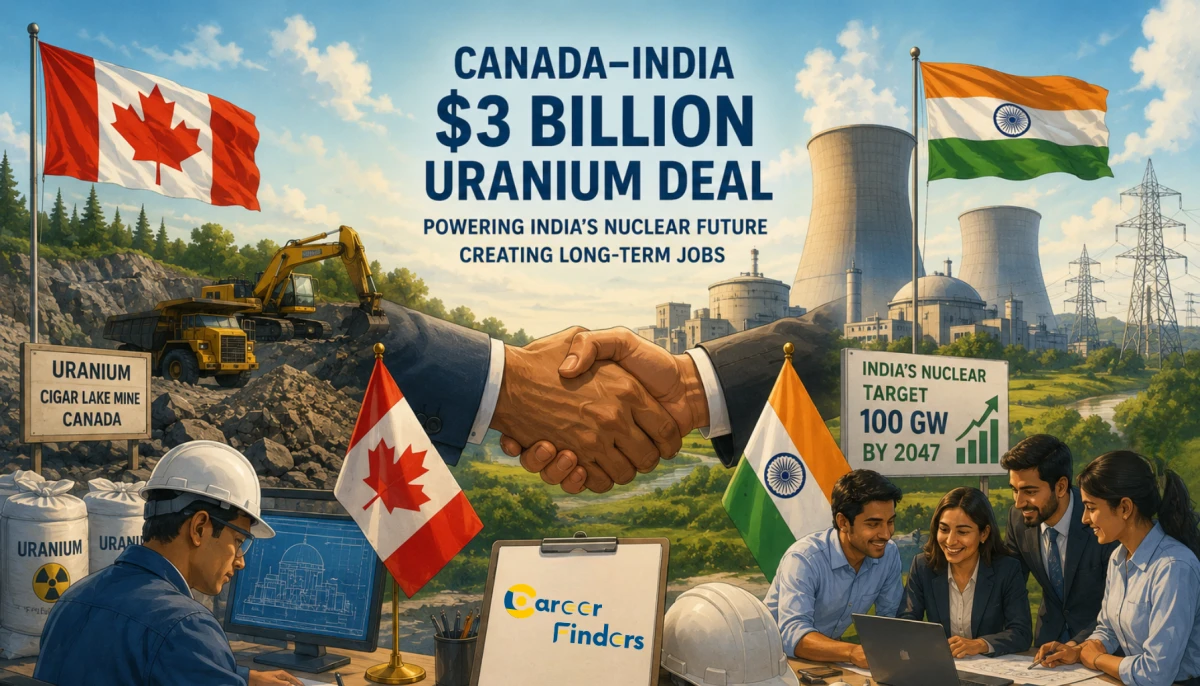
Earlier reports indicated that India and Canada were close to finalising a uranium supply agreement worth nearly $3 billion. Later reports confirmed that both countries moved forward with a major uranium supply deal, with Reuters reporting a C$2.6 billion agreement involving Canadian uranium company Cameco to support India’s nuclear energy goals.
For jobseekers, students, engineering professionals, and employers, this development matters because energy agreements of this scale do not only affect fuel supply. They influence project timelines, infrastructure investment, technical hiring, compliance demand, supply chain planning, and long-term workforce development.
Uranium is a critical fuel for nuclear power generation. When a country secures long-term uranium supply, it reduces uncertainty for nuclear projects and strengthens confidence in future power-sector expansion.
India has set an ambitious target to expand nuclear energy capacity to at least 100 GWe by 2047, according to the World Nuclear Association. That target is linked to India’s wider energy security, infrastructure, and low-carbon power strategy.
This means the Canada–India uranium deal is not just about importing fuel. It supports the foundation needed for nuclear power plants to operate, expand, and remain reliable over the long term.
For the labour market, this creates a clear message: nuclear energy is likely to remain a serious career growth sector for decades.
For jobseekers, the nuclear and power sectors offer more than short-term employment. These are long-cycle industries where projects can run for years and require continuous technical, operational, and compliance support.
As India expands its nuclear power capacity, demand may increase for professionals in:
Nuclear engineering
Electrical engineering
Mechanical engineering
Civil engineering
Instrumentation and control systems
Plant operations
Maintenance and shutdown planning
Safety inspection
Quality assurance
Radiation protection
Environmental compliance
Project management
Procurement and supply chain
Technical documentation
Energy logistics
This creates opportunities not only for highly specialised nuclear engineers, but also for workers with strong technical, industrial, construction, safety, and operations backgrounds.
For CareerFinders.co jobseekers, this is important because nuclear energy careers are often stable, regulated, and long-term. Candidates who start building relevant skills early may gain a strong advantage as the sector expands.
Students planning careers in engineering, science, energy, environment, construction, and project management should watch this deal closely.
A uranium supply agreement supports future nuclear power capacity, and future nuclear capacity requires skilled graduates. This means students should begin preparing for roles connected to:
Power systems
Energy engineering
Mechanical design
Electrical maintenance
Nuclear safety
Industrial automation
Data monitoring
Environmental science
Quality control
Materials engineering
Project coordination
Students should not wait until projects are already hiring. In technical sectors, preparation must begin early through education, internships, certifications, lab exposure, safety training, and industry awareness.
A student studying mechanical engineering, for example, may not work directly with uranium, but they may work on turbine systems, cooling systems, pumps, pressure vessels, maintenance planning, or plant infrastructure. Similarly, an electrical engineering student may work on grid connection, control panels, plant monitoring, or safety systems.
That is why nuclear growth creates opportunities across multiple career pathways.
The nuclear energy sector depends heavily on engineering talent. As India moves toward long-term nuclear expansion, engineering roles may see sustained demand.
Key areas include:
Nuclear Engineers
These professionals work on reactor systems, radiation safety, nuclear processes, plant performance, and technical risk management.
Electrical Engineers
Nuclear plants require complex electrical systems, grid integration, backup systems, control rooms, and power distribution networks.
Mechanical Engineers
Mechanical engineers support turbines, pumps, heat exchangers, cooling systems, valves, piping, pressure systems, and equipment reliability.
Civil Engineers
Large energy projects require foundations, buildings, safety structures, access roads, water systems, and construction supervision.
Instrumentation and Control Engineers
Modern power plants depend on monitoring systems, automation, sensors, alarms, and control-room technologies.
These roles require technical discipline, safety awareness, and the ability to work in highly regulated environments.
Nuclear projects do not only create jobs during construction. Once a plant is operational, it requires continuous workforce support.
Operations and maintenance roles may include:
Plant operators
Maintenance technicians
Electrical technicians
Mechanical fitters
Control room support staff
Safety officers
Inspection teams
Shutdown maintenance crews
Emergency response staff
Documentation officers
Compliance coordinators
These jobs are important because nuclear power plants must operate safely, consistently, and within strict regulatory standards. Unlike some industries where hiring rises and falls quickly, nuclear operations require long-term staffing continuity.
For skilled workers, this can mean stable career pathways with strong technical growth.
Nuclear energy is one of the most regulated industries in the world. Any expansion in this sector increases the need for professionals who understand safety, quality, documentation, inspection, and compliance.
This can create demand for roles such as:
Safety compliance officers
Radiation protection specialists
Quality assurance engineers
Risk assessment professionals
Environmental compliance officers
Regulatory documentation specialists
Audit and inspection coordinators
Emergency planning officers
Employers in this sector will not only look for technical ability. They will also value discipline, accuracy, documentation skills, and a strong safety mindset.
For jobseekers, this means compliance-related skills can become a competitive advantage.
Employers in energy, engineering, EPC, heavy manufacturing, utilities, logistics, and infrastructure should treat this deal as a long-term workforce planning signal.
Uranium supply security reduces uncertainty for nuclear power development. When fuel supply is more predictable, companies connected to the sector can plan projects, investment, recruitment, and training with more confidence.
Employers should prepare for:
Higher competition for engineering talent
Increased demand for safety-certified workers
Longer recruitment timelines for specialised roles
Need for early graduate hiring pipelines
Training demand in nuclear safety and compliance
Stronger project management requirements
Supply chain and procurement workforce expansion
Companies that wait until hiring demand becomes urgent may face talent shortages. The better strategy is to build pipelines early, identify transferable skills, and invest in workforce readiness.
A nuclear power expansion does not only involve reactors and fuel. It also requires a large industrial supply chain.
This includes:
Heavy equipment manufacturing
Metal fabrication
Precision components
Electrical systems
Safety equipment
Control systems
Construction materials
Specialised transport
Warehousing
Inspection services
Engineering consulting
Maintenance contracts
As India works toward its long-term nuclear energy ambitions, companies in these connected industries may also benefit.
This means the employment impact can spread beyond nuclear plants into manufacturing, logistics, construction, engineering services, and industrial maintenance.
For workers, this opens doors even if they do not have a nuclear-specific background. Candidates with experience in manufacturing, quality control, welding, electrical maintenance, logistics, procurement, or industrial safety may find future opportunities in nuclear-linked projects.
The uranium agreement also reflects a wider reset in Canada–India relations. Reuters reported that Canada and India are working to strengthen trade ties, with discussions covering uranium, energy, critical minerals, artificial intelligence, quantum computing, education, and culture.
Reuters also reported that both countries aim to finalise a free trade agreement by the end of the year and increase bilateral trade significantly by 2030.
This is important because stronger trade relations can create additional opportunities beyond nuclear energy. Cooperation in critical minerals, clean energy, advanced technology, education, and infrastructure can influence future hiring across multiple sectors.
For CareerFinders.co readers, this means the uranium deal should be viewed as part of a larger employment and trade trend, not as an isolated energy announcement.
Nuclear power projects are different from short-term business trends. They require years of planning, construction, operation, maintenance, safety management, and regulatory oversight.
That creates multi-decade career potential.
India’s target of at least 100 GWe of nuclear energy by 2047 shows that nuclear power is being positioned as part of the country’s long-term energy roadmap.
For jobseekers, this means nuclear energy can offer career opportunities in:
Government-backed energy projects
Public sector and private sector engineering
Power generation
Industrial construction
Plant operations
Technical maintenance
Environmental compliance
Research and development
Energy policy and planning
For students, it means nuclear energy should be considered seriously when choosing engineering, science, and technology pathways.
Jobseekers interested in energy and nuclear-linked careers should focus on practical, technical, and compliance-based skills.
Useful skills include:
Technical drawing and documentation
Electrical systems understanding
Mechanical maintenance knowledge
Workplace safety awareness
Project coordination
Quality control processes
Data monitoring and reporting
Industrial equipment knowledge
Environmental compliance basics
Communication and reporting skills
Problem-solving under regulated conditions
Candidates should also build strong resumes that clearly show technical training, certifications, project experience, internships, safety exposure, and industry knowledge.
A general resume may not be enough for specialised sectors. Employers in energy and infrastructure often prefer candidates who can show discipline, reliability, and practical understanding.
At CareerFinders.co, we track developments that shape real employment outcomes.
The Canada–India uranium agreement is one of those developments. It connects energy security with workforce demand, engineering growth, industrial hiring, and long-term career planning.
For jobseekers, this is a signal to build future-ready technical skills.
For students, this is a reminder to align education choices with sectors that have long-term government and industry backing.
For employers, this is a workforce planning opportunity.
For recruiters, this is a chance to build early talent pools in engineering, energy, infrastructure, compliance, and project delivery.
The most important point is this: nuclear energy growth does not create jobs overnight, but it creates strong hiring direction. Candidates and employers who prepare early will be better positioned when demand increases.
The Canada–India uranium deal is not only an energy agreement. It is a long-term career signal.
By strengthening uranium supply, India gains more confidence to expand nuclear power capacity. That expansion can support jobs across engineering, construction, plant operations, safety, compliance, logistics, and industrial supply chains.
For jobseekers, the message is clear: energy careers are becoming more strategic.
For students, the message is clear: technical and STEM skills will matter.
For employers, the message is clear: workforce planning must begin before hiring pressure peaks.
CareerFinders.co will continue covering global developments that affect jobs, hiring, education, and workforce demand.
Explore energy, engineering, and infrastructure career opportunities at:
https://careerfinders.co/
Forbes
Canada Nears $3 Billion Uranium Deal With India
👉 https://www.forbes.com/sites/gauravsharma/2026/02/01/canada-nears-3-billion-uranium-deal-with-india-may-be-inked-in-march/
Reuters
Canada PM Mark Carney Likely to Visit India to Advance Trade and Uranium Talks
👉 https://www.reuters.com/world/carney-likely-visit-india-early-march-canada-trade-pivot-intensifies-envoy-says-2026-01-26/
The Economic Times
India Set to Ink 10-Year Uranium Supply Deal During Canadian PM Visit
👉 https://economictimes.indiatimes.com/news/economy/foreign-trade/india-set-to-ink-10-yr-uranium-supply-deal-during-canadian-pm-mark-carneys-visit/articleshow/127726325.cms
Times of India
Canada Plans to Double $30 Billion Trade With India by 2030
👉 https://timesofindia.indiatimes.com/city/goa/plan-to-double-30bn-trade-with-india-by-2030-canada/articleshow/127724014.cms
World Nuclear Association
India’s Nuclear Power Programme and 100 GW Target
👉 https://world-nuclear.org/information-library/country-profiles/countries-g-n/india.aspx
#EnergyJobsIndia #NuclearEngineering #PowerSectorJobs #InfrastructureCareers #STEMCareers #EngineeringCareers #CleanEnergyJobs #NuclearIndustry #EnergyHiring #SkilledJobs #PublicSectorCareers #LongTermCareers #FutureOfWork #CareerGrowth #EmploymentTrends