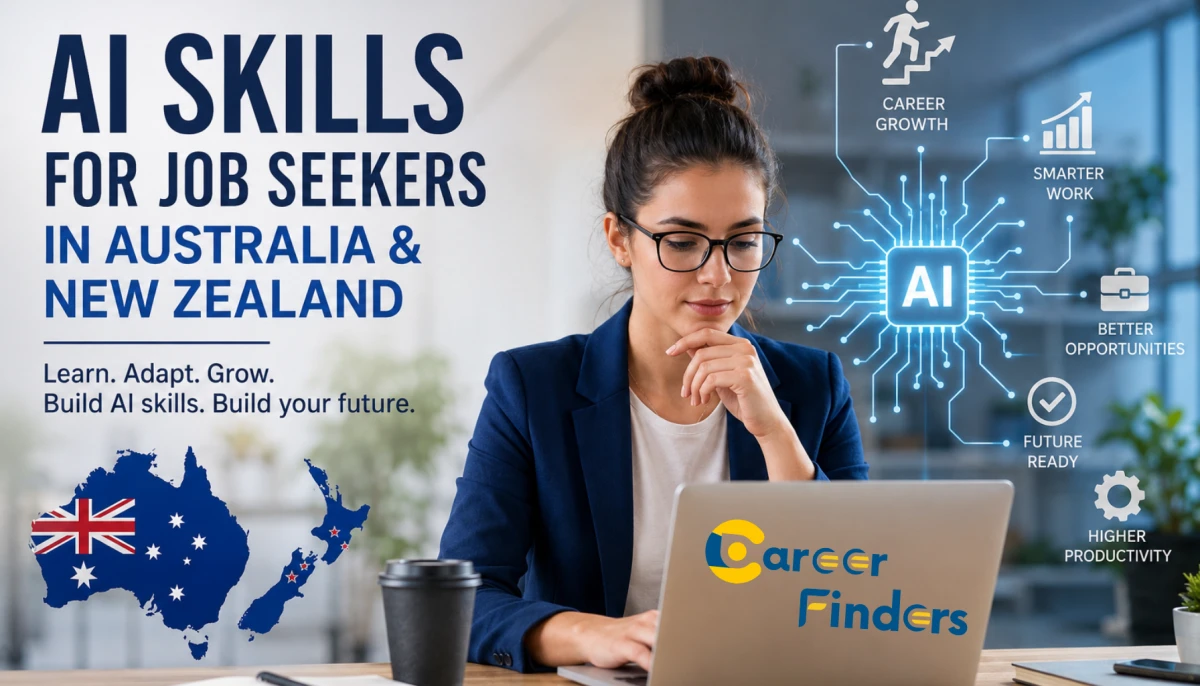
The job market in Australia and New Zealand is changing quickly. A few years ago, most employers mainly focused on qualifications, work experience, communication skills and industry knowledge. These things are still important, but now one more skill area is becoming valuable: artificial intelligence.
AI is no longer only for software engineers, data scientists or technology companies. It is now being used in administration, marketing, customer service, healthcare, finance, education, recruitment, sales, business operations and many other industries. For this reason, job seekers who understand how to use AI tools responsibly can become more competitive in the modern job market.
This does not mean every student, fresher or job seeker must become an AI expert. It also does not mean that every job will become a technology job. The real point is simple: people who can use AI to save time, improve work quality, solve problems and learn faster may have an advantage over people who ignore these tools completely.
In Australia, Jobs and Skills Australia has identified technological change and shifting skill demand as major forces shaping the future workforce. Its Jobs and Skills Report explains that Australia’s workforce planning, education and training systems need to align with changing skill needs, including digital and technology-related capabilities.
For New Zealand, AI is also becoming more visible in recruitment and workplace trends. SEEK New Zealand reported that employers are using AI for tasks such as writing job descriptions, screening resumes and scheduling interviews, while candidates are using AI to help with resumes, cover letters and interview preparation.
This shows one important thing: AI is not just changing how people work. It is also changing how people apply for jobs, how employers hire and how candidates prepare for career growth.
AI skills matter because workplaces are becoming more digital, faster and more competitive. Employers want people who can adapt to new systems, understand modern tools and complete work more efficiently. Even in non-technical roles, AI can support writing, planning, research, reporting, customer communication and task management.
For example, a marketing assistant can use AI to create campaign ideas, improve captions and analyse customer trends. An office administrator can use AI to draft professional emails, summarise documents and organise information. A student can use AI to practise interview questions or understand a complex topic. A business owner can use AI to improve job descriptions, compare resumes and prepare onboarding documents.
SEEK Australia has reported that mentions of AI in job ads have increased by more than 80% since 2024, showing that AI skills are becoming more visible in hiring requirements across different roles.
This is why job seekers should not treat AI as a temporary trend. It is becoming part of the normal workplace. Candidates who learn AI basics now can prepare themselves for future opportunities and show employers that they are flexible, modern and ready to learn.
One common mistake many job seekers make is thinking that AI is only useful for IT, software development or data science. That is not true anymore. AI is now useful in almost every field where people work with information, customers, documents, planning or decision-making.
In business roles, AI can help with reports, research and presentations. In customer service, it can help staff prepare responses and understand customer needs. In healthcare administration, AI can support documentation and scheduling. In education, it can help with lesson planning, study support and learning resources. In hospitality and retail, AI can support rostering, customer feedback analysis and marketing content.
The World Economic Forum’s Future of Jobs Report highlights that technology-related skills, including AI and big data, networks and cybersecurity, and technological literacy, are expected to become more important as employers respond to workforce transformation.
This means AI awareness is becoming a general career skill, not only a technical skill. A person does not need to build AI software to benefit from AI. They need to understand how to use AI tools properly, how to check results and how to apply AI in real workplace situations.
When people hear “AI skills”, they often think about coding, machine learning or advanced technical knowledge. Those skills are useful for specialised roles, but basic AI skills are different.
For most job seekers, AI skills mean being able to use AI tools in a practical and responsible way. This includes writing good prompts, checking AI-generated answers, using AI to improve productivity, understanding the limits of AI and applying AI output to real tasks.
Important AI skills for job seekers include:
Prompt writing means giving clear instructions to AI tools. A weak prompt gives weak results. A strong prompt gives better, more useful results.
For example, instead of writing “make resume”, a better prompt would be:
“Create a professional resume summary for a customer service assistant with two years of experience in retail, strong communication skills and experience handling customer complaints.”
This kind of prompt gives AI more context, so the answer becomes more useful.
AI can help job seekers understand industries, job roles, company requirements and interview topics. But candidates should not blindly trust everything AI says. They should verify important facts, especially salary, visa, legal, education and employer-related information.
AI can help improve resume wording, structure and clarity. It can help job seekers match their experience with a job description. However, candidates must keep their resume honest. Adding fake skills or fake experience may create problems during interviews or background checks.
AI can help create a first draft of a cover letter. But the final version should include the candidate’s real interest, real experience and clear reason for applying. A generic AI-written cover letter can sound polished but still fail to impress employers.
AI tools can generate common interview questions, role-specific questions and sample answers. Job seekers can practise with these questions before the real interview. This is especially useful for students and freshers who may not have much interview experience.
Many jobs now require basic data understanding. AI can help explain spreadsheet formulas, summarise data and identify trends. Even simple skills like Excel, Google Sheets and basic reporting can become more powerful when combined with AI tools.
This is one of the most important AI-related skills. AI can make mistakes, create outdated answers or sound confident even when the answer is wrong. Job seekers must learn to review, edit and question AI output.
Students should not wait until they finish their course to learn AI skills. The earlier they start, the more confident they will become before entering the workforce.
AI tools can help students understand difficult topics, summarise study material, prepare notes, practise English communication, build resumes and explore career options. This can be useful for students in business, IT, hospitality, healthcare, engineering, education, accounting, marketing and many other fields.
But students must use AI as a learning support tool, not as a shortcut. If students only copy AI answers without understanding the topic, they may pass an assignment but fail to build real knowledge. Employers do not only want candidates who can generate content. They want candidates who can think, explain, communicate and solve problems.
Students can use AI in better ways by asking it to explain concepts, create practice questions, compare career options, review resume drafts and suggest interview preparation topics.
For example, a student studying business can ask AI to explain customer service strategy. A student studying IT can ask AI to explain cybersecurity basics. A student studying hospitality can use AI to practise workplace communication scenarios.
This kind of use helps students become more job-ready.
Freshers often face one common problem: they have qualifications but limited work experience. AI skills can help them bridge this gap.
A fresher can use AI to understand job descriptions, identify missing skills, improve resume language and prepare for interviews. They can also use AI to create a learning plan for the type of job they want.
For example, if a fresher wants to apply for an administration assistant role, AI can help them identify useful skills like email writing, scheduling, Microsoft Office, customer communication and data entry. If a fresher wants a marketing role, AI can help them understand content writing, social media planning, SEO basics and campaign reporting.
Freshers can also include AI-related skills on their resume, but only if they genuinely know how to use them. For example:
“Basic experience using AI tools for research, document drafting, interview preparation and productivity support.”
This sounds realistic and honest. It is better than writing “AI expert” when the candidate only has basic knowledge.
AI skills are not only useful for students and freshers. Experienced professionals also need to keep learning because many roles are changing.
A person with five or ten years of experience may have strong industry knowledge, but if they cannot adapt to new tools, they may fall behind. Employers often value experienced workers who can combine industry knowledge with digital confidence.
For example, an experienced HR professional can use AI to draft job descriptions, prepare interview questions and summarise candidate profiles. A finance professional can use AI to explain reports, detect trends and improve presentations. A manager can use AI to prepare meeting notes, project plans and communication drafts.
The strongest professionals will not be those who use AI for everything. They will be those who know when to use AI, when to rely on human judgment and how to improve AI output with real experience.
AI is already changing recruitment in Australia and New Zealand. Employers are using AI tools to speed up hiring, manage applications and improve recruitment workflows.
SEEK New Zealand reported that businesses are using AI in recruitment for job description writing, resume screening and interview scheduling. It also reported that candidates are using AI for resumes, cover letters and interview preparation.
This creates both opportunities and risks.
For employers, AI can reduce manual work and help hiring teams manage large numbers of applications. For candidates, AI can help improve applications and interview preparation. But if everyone uses AI in the same way, applications can start to look similar.
This is why job seekers must avoid submitting generic AI-written resumes and cover letters. Employers can usually notice when an application sounds too general, too polished or not connected to the real job.
A strong application should still include the candidate’s real experience, achievements, skills and motivation.
Using AI is not wrong. The problem happens when job seekers depend on AI too much and remove their own voice.
A good AI-assisted application should still sound like a real person. It should include specific examples from the candidate’s experience. It should match the job description but not copy it blindly. It should be clear, simple and honest.
Job seekers can use this process:
This method helps candidates use AI as a support tool, not as a replacement for their own thinking.
Job seekers should only add AI skills they can explain in an interview. If an employer asks, “How have you used AI tools?”, the candidate should be able to answer clearly.
Good AI-related resume skills include:
A simple resume line can be:
“Confident using AI tools to support research, document preparation, interview practice and workplace productivity.”
Another stronger version can be:
“Used AI tools to improve report drafting, summarise information and prepare structured communication for workplace tasks.”
These lines are professional and realistic.
AI skills can be used differently depending on the career field.
Administrative workers can use AI for email drafting, meeting notes, document formatting, task planning and data entry support.
Marketing job seekers can use AI for content ideas, social media captions, keyword research, blog outlines, campaign planning and competitor research.
Customer service candidates can use AI to practise responses, improve communication and understand customer complaint handling.
HR professionals can use AI for job descriptions, interview questions, candidate summaries and onboarding content.
Finance workers can use AI to explain reports, summarise financial information and prepare presentation drafts.
Healthcare administration workers can use AI for appointment communication, process documentation and patient service support, while still following privacy rules.
Teachers and trainers can use AI for lesson ideas, quiz creation, student support material and learning resources.
IT candidates can use AI for code explanation, troubleshooting, documentation, cybersecurity learning and technical interview practice.
Even though AI skills are important, human skills are still essential. Employers do not want people who only know how to use tools. They want people who can communicate, think, work in teams and solve real problems.
AI can generate text, but it cannot replace genuine workplace behaviour. It cannot replace empathy in customer service, leadership in a team, honesty in a resume or confidence in an interview.
Important human skills include:
Communication
Teamwork
Problem-solving
Adaptability
Leadership
Time management
Creativity
Professional behaviour
Customer focus
Decision-making
The best career strategy is not “AI skills versus human skills”. The best strategy is to combine both.
A candidate who has communication skills plus AI skills can be more productive. A manager with leadership skills plus AI skills can make better decisions. A student with learning ability plus AI skills can prepare faster for the job market.
Employers should not only ask whether a candidate knows AI. They should ask how the candidate uses AI.
A good candidate should be able to explain:
What tools they have used
What tasks they used AI for
How they checked the output
How they avoided mistakes
How AI helped them work better
How they protected privacy and accuracy
Employers should also be careful when using AI in hiring. AI can support recruitment, but it should not fully replace human judgment. Hiring decisions should still consider experience, attitude, communication, potential and fairness.
The World Economic Forum report is based on the views of more than 1,000 employers representing over 14 million workers across 55 economies, showing that workforce transformation is a major global concern for businesses.
For employers in Australia and New Zealand, the message is clear: hiring should become more skills-focused. Instead of only looking at degrees or years of experience, employers should also check whether candidates can learn, adapt and work with modern tools.
The job search process itself is becoming smarter. Candidates are using AI to prepare applications. Employers are using AI to manage hiring. Job platforms are using technology to improve matching between candidates and roles.
This means job seekers must become more strategic. Mass applying to hundreds of jobs with the same resume may not work well. Instead, candidates should apply carefully, customise their resume, use relevant keywords and prepare properly for interviews.
SEEK Australia advises job seekers to include relevant skills from the job description in their resume because many employers use Applicant Tracking Systems to help manage applications and screen resumes.
This is where AI can help. Candidates can use AI to compare their resume with a job description and identify missing keywords. But they should only add skills they truly have.
A smart job search is not about sending more applications. It is about sending better applications.
CareerFinders.co can support job seekers by helping them explore job opportunities, understand career trends and prepare for a changing employment market in Australia and New Zealand.
For students and freshers, CareerFinders can be a useful platform to discover career options, understand job categories and learn what employers are looking for.
For experienced professionals, it can support smarter job searching by helping them stay aware of market trends and relevant opportunities.
For employers, CareerFinders can support hiring by connecting them with candidates who are actively looking for work and building their career path.
As AI changes the job market, career platforms need to do more than only list jobs. They need to help people understand skills, preparation and better career decisions. CareerFinders can position itself as a platform that supports both opportunity and readiness.
Job seekers who want to build AI skills can start with simple steps.
Start by learning one AI tool. Use it for research, resume improvement and interview practice. Then learn how to write better prompts. After that, use AI to understand job descriptions and identify skills you need to improve.
Candidates can also practise by asking AI to generate interview questions for a specific role. For example:
“Give me 10 interview questions for an entry-level marketing assistant role in Australia.”
Then they can practise answering those questions in their own words.
Job seekers should also build proof of skill. For example, a marketing candidate can create sample social media posts. An administration candidate can prepare a sample professional email. An IT candidate can create a small project or GitHub sample. A design candidate can create a portfolio.
Employers are becoming more interested in practical ability. AI can help candidates prepare, but real examples still matter.
Many candidates use AI, but not all use it properly. Some mistakes can reduce their chances of getting hired.
The first mistake is copying AI answers without editing. This makes the resume or cover letter sound generic.
The second mistake is adding fake skills. If a candidate writes “advanced AI experience” but cannot explain it in an interview, it creates a bad impression.
The third mistake is using the same resume for every job. AI can help customise resumes, but the candidate must still make each application relevant.
The fourth mistake is ignoring human communication. Even if the resume is strong, the candidate still needs to speak clearly in interviews.
The fifth mistake is trusting AI completely. AI can make errors, so job seekers must check facts and review everything before submitting.
AI skills are becoming important for job seekers, students and employers across Australia and New Zealand. The future job market will reward people who can learn quickly, adapt to change and use technology responsibly.
Students should start learning AI basics early. Freshers should use AI to improve preparation and show digital confidence. Experienced professionals should use AI to stay relevant and improve productivity. Employers should look for candidates who can combine practical skills, human judgment and technology awareness.
AI will not remove the need for human skills. Communication, problem-solving, teamwork and professionalism will still matter. But candidates who combine these human skills with AI confidence may have stronger career opportunities.
The best time to start learning AI skills is now. Start small, practise regularly and use AI as a tool to improve your career preparation.
CareerFinders.co can help job seekers an
(1) The job market is becoming more competitive because AI-driven hiring systems and automation are changing how candidates apply and how employers shortlist talent.
https://www.theguardian.com/technology/ng-interactive/2026/apr/25/gen-z-entrepreneurs-business-ai
(2) Targeted job search strategies, recruiter outreach and smarter networking can give candidates better results than mass applying to hundreds of jobs.
https://www.businessinsider.com/job-seeker-landed-role-from-reddit-hack-find-recruiter-email-2026-4
(3) Many resumes may not reach human recruiters because AI screening systems and Applicant Tracking Systems filter applications before manual review.
https://www.techradar.com/pro/75-of-resumes-never-reach-a-human-heres-the-hidden-reason-your-application-is-getting-rejected-by-ai
(4) Recruiters still play an important role in hiring, but job seekers should verify recruiter authenticity and be careful of fake hiring or recruitment scams.
https://www.wsj.com/lifestyle/careers/a-recruiter-found-you-or-is-it-a-scam-d912159a
(5) Hiring methods are changing, and some companies are moving beyond traditional resume-based hiring by focusing more on skills, ability and practical performance.
https://timesofindia.indiatimes.com/life-style/spotlight/no-resume-hiring-founders-bold-recruitment-strategy-goes-viral/articleshow/130531694.cms
#AISkills #JobSeekers #CareerFinders #AustraliaJobs #NewZealandJobs #FutureOfWork #AIInRecruitment #JobSearchTips #StudentsCareer #FreshersJobs #CareerGrowth #DigitalSkills #ResumeTips #InterviewPreparation #WorkplaceSkills